Funding D303’s Referendum—and Who Could Be Paid AS A RESULT
TAXPAYERS WILL CARRY THE BURDEN FOR 25 YEARS
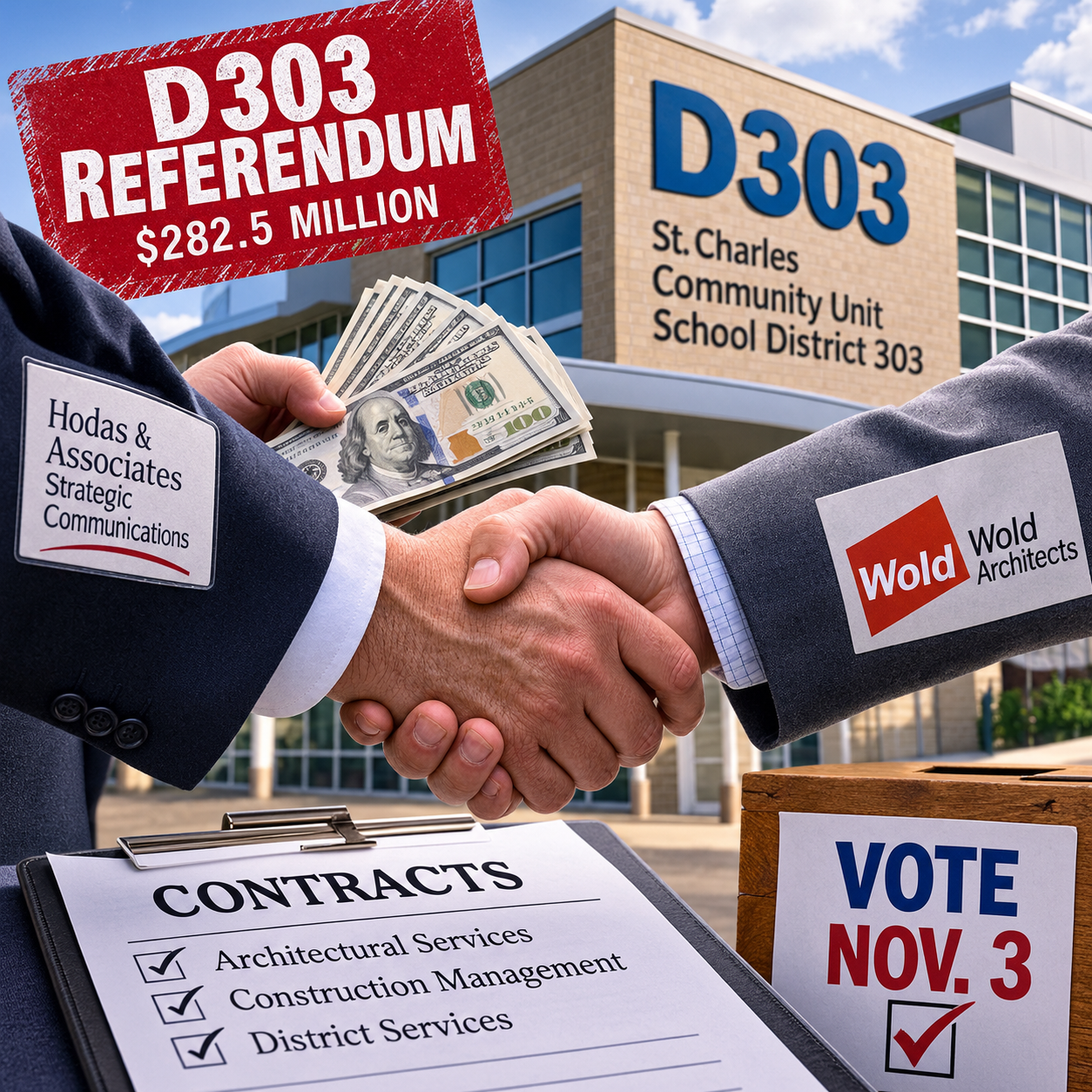
For starters, A political communications firm, an architectural firm with district experience, and the financial questions voters deserve answered
Kane County Speaks | October 2026
Before voters authorize hundreds of millions of dollars in school borrowing, they deserve to understand more than the proposed construction projects. They also deserve to know who is financing the campaign supporting that borrowing (that you, the consumer will pay for over 25+ years)—and whether those contributors have existing or potential business with the district.
On November 3, voters will decide whether St. Charles Community Unit School District 303 may issue $282.5 million in bonds. According to the district’s referendum information, the bonds would help finance a $312.5 million facilities program, with another $30 million coming from district resources. District 303
Two different financial relationships deserve examination: what contributors give to the referendum campaign, and what the district pays—or could pay—those contributors.
A campaign contribution does not prove that anyone has purchased influence or secured a contract. But an existing commercial relationship should not disappear from the discussion either.
Hodas & Associates: $31,000 in noncash campaign support
Illinois Sunshine’s October 8 contribution listing identifies a $31,000 in-kind contribution from Hodas & Associates Strategic Communications to St. Charles Our Kids, Our Community, the referendum-supporting committee. This was reported as noncash support—not a $31,000 check. Illinois Sunshine
Hodas’s own website describes services including "political consulting, polling, direct mail, digital advertising, television and radio production, and telephone outreach." Those services are relevant to promoting a referendum. The contribution listing reviewed, however, does not identify precisely what the $31,000 covered. Hodas and Associates
That leaves a straightforward question: What did Hodas provide, and who arranged for it? Another important question is "why would taxpayer dollars be used to hire these consultants to lobby for more taxes?"
The supporting documentation should identify the goods or services, how their value was calculated, and whether the campaign separately purchased additional work from the firm.
Another question concerns the school district itself: Has D303 ever hired or paid Hodas, directly or through another contractor?
This review did not establish a district contract or district payment to Hodas. That relationship should therefore be investigated—not asserted as fact.
How could Hodas benefit?
Hodas could receive revenue from separately paid campaign or consulting work, if such an arrangement exists. But that would be different from receiving architectural or construction fees from a voter-approved building program. No agreement reviewed establishes that Hodas would receive compensation contingent on the referendum passing. Its in-kind contribution alone establishes neither a paid engagement nor a right to future district work.
The documents needed here are specific: the contribution description, campaign expenditures and unpaid obligations, and any district contracts or invoices involving the firm. Voters should be able to distinguish donated campaign assistance from paid campaign services—and both from taxpayer-funded district work.
Wold Architects: Past district work and a potential connection to future construction
The donor summary supplied for this review lists $4,946.19 associated with Wold Architects. Illinois Sunshine independently identifies a $3,500 "in-kind contribution" on October 1. The additional $1,446.19 in the supplied total has not been reconciled to an original transaction record. Readers can examine the October 1 listing here. Illinois Sunshine
Unlike the unresolved question about Hodas’s district work, Wold has a documented professional relationship with D303.
On its D303 project page, Wold states that it partnered with the district in 2019 on master facility planning, identifying short- and long-term priorities. It also documents its work converting the Haines Center into an Early Childhood Center, completed in August 2024. Wold Architects & Engineers
That establishes prior planning and design work. It does not, by itself, establish the amount D303 paid Wold, the terms of those agreements, or whether Wold already has an agreement covering the proposed referendum projects.
Who has a financial interest in Wold?
Wold’s financial stakeholders extend beyond the people whose names appear on its architectural work.
In 2025, Providus Capital Partners announced an equity partnership with Wold Architects & Engineers. The transaction announcement identified Vaughn Dierks as Wold’s continuing chief executive and described plans to accelerate growth and expand services and markets. Financial terms were not disclosed. Business Wire
The announcement also described Wold’s exposure to “stable, publicly funded sectors” as part of its appeal to the investment firm. That is the investor’s own description of the business—not an allegation about its conduct. Business Wire. The public announcement establishes an equity-investment relationship. It does not disclose a complete ownership roster, ownership percentages, or the transaction’s control provisions.
How could Wold benefit?
The potential commercial benefit is direct and understandable: if Wold receives contracts for additional planning, architectural, engineering, or related services, it would earn fees for that work. Profitable additional work could benefit the firm and its equity holders.
That is a conditional business consequence—not a finding that Wold has already secured those contracts. But the appearances are particularly disconcerting.
The questions for D303 are therefore concrete:
How much has the district paid Wold since the 2019 planning engagement, and for which projects? Was Wold involved in developing the scope or cost estimates for this referendum? Does any existing agreement authorize additional work if the referendum passes? Would Wold and all of any directly and indirectly affiliated entity decline any work for which they would get paid over the same 25 years that each tax payer would have to pay?
For future work, voters should also be able to see the selection process, scope of services, fee structure, and board approval.
Without those agreements, it would be irresponsible to estimate what Wold might earn by applying an assumed percentage to the entire referendum amount. Though disclosed, the conflict could be financially burdensome for every D303 taxpayer.
The legitimate question is not whether an architectural firm may support school improvements. It is whether that firm will also be paid to design or oversee the improvements—and under what publicly disclosed terms.
Before the vote, show the agreements
The most useful disclosure would connect three things: past district payments, existing contractual commitments, and potential future work.
D303’s Business Services page provides access to financial disclosures, including contract-related information. Its public-records page explains how residents can request additional documents. District 303
For this referendum, the district should make the relevant agreements and payment histories easy to find—not leave residents to guess about them. The evidence supports scrutiny of the commercial relationships. It does not support treating every donor as someone expecting a payout.
Taxpayers deserve the contracts, the fees, and the facts before they vote.
Reporting note: Hodas’s $31,000 in-kind contribution and Wold’s $3,500 in-kind transaction were independently located in Illinois Sunshine’s daily listings. Wold’s larger total and the individual contribution amounts above come from the donor summary supplied for this review. Complete district contract and payment histories were not obtained.
Latest Articles, Submissions & Community Highlights
Participating groups, neighborhood leaders, and citizen coalitions can share news, documents, or resources here.