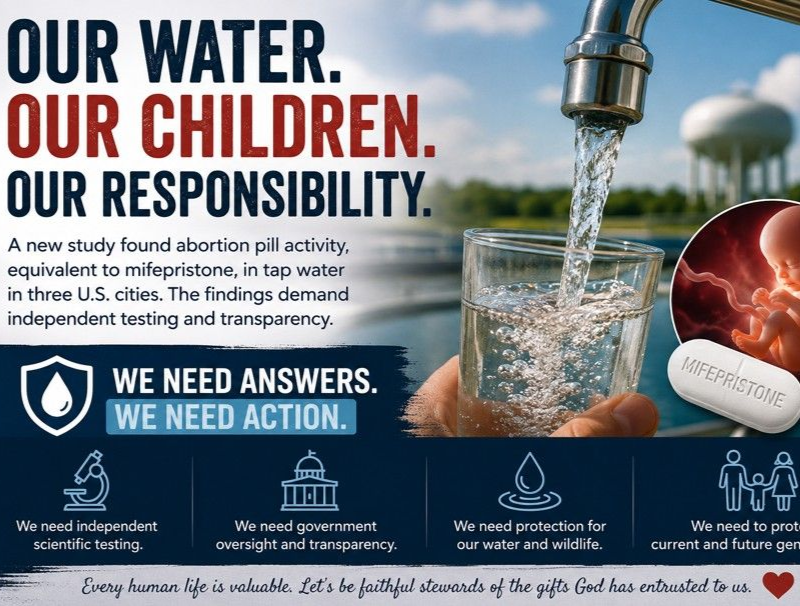
A newly published study is raising serious questions about whether traces of the abortion pill could be making their way into America's drinking water.
Researchers reported finding anti-progesterone activity, described as being equivalent to the abortion drug mifepristone, in tap water samples collected from three U.S. cities: Carbondale, Illinois, Austin, Texas, and Blacksburg, Virginia. The study does not claim that the water is unsafe to drink, but it does argue that the findings deserve much more investigation.
The researchers believe traces of the drug may enter wastewater after women take the abortion pill. From there, they say some of it could pass through wastewater treatment plants and eventually return to rivers, lakes, and drinking water supplies. The study calls for additional testing to determine how often this occurs and whether there are any risks to people or wildlife.
Not everyone agrees with the study's conclusions. Some environmental scientists and public health experts say there is currently no evidence that the reported levels pose a danger to human health. They argue that many medications can be detected in water at extremely small concentrations and that finding a substance does not automatically mean it is harmful.
Still, the study raises an important question. If traces of a drug designed to end a pregnancy are entering public water systems, shouldn't we know more about it? That question alone deserves serious attention, regardless of where someone stands on abortion.
Several pro-life organizations are calling on the Environmental Protection Agency to conduct independent testing and determine whether mifepristone should be added to the agency's list of contaminants for further study. That request is not a call for panic. It is a call for transparency and sound science.
This issue is bigger than politics. Americans expect their drinking water to be carefully monitored and thoroughly tested. If a credible study identifies a possible concern, the responsible response is not to ignore it. The responsible response is to investigate it.
Whether future research confirms or refutes these findings, the public deserves clear answers based on independent scientific evidence. Until those answers are available, continuing to study this issue is a reasonable and responsible course of action.
https://issuesinlawandmedicine.com/articles/abortifacient-activity-found-in-municipal-drinking-water/
https://www.lifenews.com/2026/07/25/study-finds-abortion-pill-traces-in-u-s-tap-water-pro-life-groups-call-for-action/
https://decisionmagazine.com/abortion-pill-contaminates-water-supply-in-us-cities/
https://www.legalnewsline.com/louisiana-record/murrill-asks-epa-to-conduct-abortion-pill-water-safety-tests/article_5abf0439-b714-47a4-a0f3-93d02f619a2b.html