
Federal Court Clears the Way for Planned Parenthood to Direct Minors to Out-of-State Abortions
illinois is critical
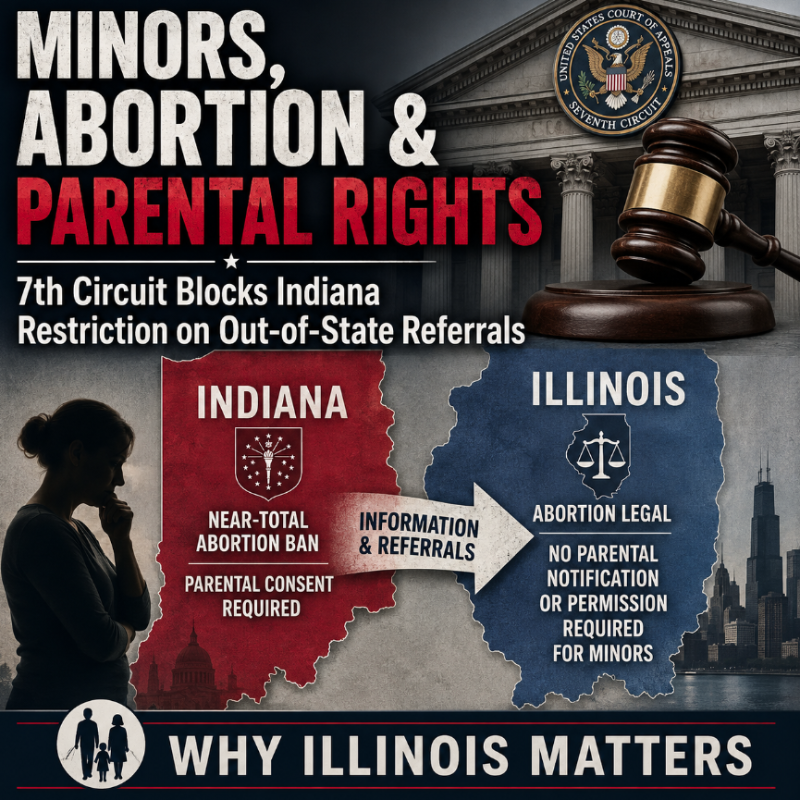
A federal appeals court has ruled that Indiana cannot stop Planned Parenthood from giving pregnant minors information or referrals to abortion providers in other states, even when the girl's parents have not consented. The August 18, 2026 ruling from the U.S. Court of Appeals for the Seventh Circuit upheld a permanent injunction against part of Indiana's 2017 "aid-or-assist" law. That law was designed to prevent people from helping an unemancipated minor obtain an abortion without satisfying Indiana's parental-consent requirements.
The case has a particularly troubling connection to Illinois. Indiana now prohibits most abortions, while Illinois has moved in the opposite direction. A girl under 18 does not need to notify or obtain permission from her parent or legal guardian before receiving an abortion in Illinois. That means the combination of Illinois law and this new federal court ruling creates a clear pathway for an Indiana minor to receive information about an Illinois abortion provider without her parents' consent.
What the Court Actually Ruled
This case needs to be described carefully.
The Seventh Circuit did not rule that minors have a constitutional right to obtain abortions without their parents. It also did not overturn Indiana's near-total abortion ban.
Instead, the court ruled that Indiana cannot use its "aid-or-assist" law to stop Planned Parenthood from providing minors with truthful information or referrals concerning abortion providers operating legally in another state.
Judge David Hamilton wrote the majority opinion. The court concluded that Indiana's restriction, as applied to these referrals, violated the First Amendment because it restricted speech based on its content.
The court pointed to a simple comparison. Planned Parenthood could provide a pregnant minor with information about an out-of-state doctor providing prenatal care without violating the law. It could provide information about treatment for a sexually transmitted infection. But if it provided information about an abortion provider, Indiana's law could impose penalties.
The majority concluded that this distinction amounted to an unconstitutional restriction on protected speech.
Why Illinois Matters
This is where the ruling becomes much more than an Indiana story.
The Seventh Circuit covers Illinois, Indiana and Wisconsin. More importantly, Illinois is geographically accessible to many Indiana residents and has deliberately established strong legal protections for abortion access.
Illinois repealed its Parental Notice of Abortion Act effective June 1, 2022. As a result, Illinois government guidance states plainly that a person under 18 seeking an abortion does not need to notify or receive permission from a parent or legal guardian.
Consider what that means in practice.
A 16-year-old girl in Indiana could seek information from Planned Parenthood without her parents' consent. Planned Parenthood may provide her with information about an abortion provider operating legally in Illinois. Once in Illinois, state law does not require her to obtain her parents' permission or even notify them before the abortion.
That does not mean the Seventh Circuit ordered Planned Parenthood to make such referrals. It means Indiana cannot enforce the challenged law against Planned Parenthood merely for providing accurate information or referrals concerning abortions that are legal where they would occur.
What About Parents?
This is the question that should concern families regardless of where they stand politically.
At what point should parents have a right to know that their minor daughter is facing a pregnancy and considering an abortion?
Indiana argued that its law served legitimate interests in parental involvement and responsibility for children. The Seventh Circuit acknowledged that those interests are legitimate. But the majority concluded that they were not enough to justify this particular restriction on speech.
The court also emphasized that Indiana cannot extend its own abortion laws across state borders and prohibit conduct that another state has made legal.
That creates an extraordinary conflict between states.
Indiana has decided that unborn children deserve extensive legal protection and that parents should generally be involved when their minor daughter faces an abortion decision. Illinois has adopted dramatically different policies. Illinois permits abortion and has eliminated its parental-notification requirement.
Now the federal appeals court has said Indiana cannot prevent Planned Parenthood from telling minors about the abortion services legally available across that state line.
There Are Limits to the Decision
The ruling is not unlimited.
The Seventh Circuit specifically distinguished referrals for legal out-of-state abortions from assistance with an illegal abortion inside Indiana.
The court said speech that actually assists someone in obtaining an illegal abortion in Indiana could potentially be treated as speech connected to unlawful conduct. The injunction protects Planned Parenthood's ability to provide information about providers performing abortions legally in other states.
That distinction matters.
The ruling therefore should not be described as a court "legalizing abortion for minors in Indiana." That would be inaccurate.
What the court has done is prevent Indiana from using this law to stop Planned Parenthood from directing minors toward abortion providers operating legally outside Indiana.
The Bigger Question
The decision exposes one of the enormous consequences of America's post-Dobbs abortion landscape.
States now have dramatically different laws governing unborn children, abortion and parental involvement.
Indiana can prohibit most abortions within Indiana.
But it cannot force Illinois to adopt the same policy.
And according to the Seventh Circuit, Indiana also cannot prohibit Planned Parenthood from giving a minor truthful information about an abortion that is legal in Illinois simply because Indiana strongly objects to what may happen after she crosses the state line.
For parents, the result is difficult to ignore.
A minor girl living in Indiana could potentially be directed toward an Illinois abortion provider without her parents' permission, and Illinois law would not require those parents to be notified before their daughter's abortion.
Whatever legal language surrounds this case, that is the practical issue families need to understand.
Sources
U.S. Court of Appeals for the Seventh Circuit
Planned Parenthood Great Northwest, Hawai'i, Alaska, Indiana, Kentucky, Inc. v. Commissioner, No. 24-2219, decided August 18, 2026.
City of Chicago, Chicago Department of Public Health
Official abortion-care guidance confirming that minors in Illinois do not need parental notification or permission.
https://www.chicago.gov/city/en/depts/cdph/provdrs/healthy_families/svcs/abortion-care.html
Indiana Lawyer
August 18, 2026 coverage of the Seventh Circuit decision.
Courthouse News Service
August 18, 2026 coverage of the decision and arguments concerning out-of-state abortion referrals.
https://www.courthousenews.com/articles/seventh-circuit-dumps-ban-on-abortion-info-for-minors
Latest Articles, Submissions & Community Highlights
Participating groups, neighborhood leaders, and citizen coalitions can share news, documents, or resources here.