
What happens in an abortion - PART 5 of 5
Behind the Medical Terminology
For four articles, I have asked one simple question:
What actually happens during an abortion?
We examined the abortion pill.
We examined suction aspiration.
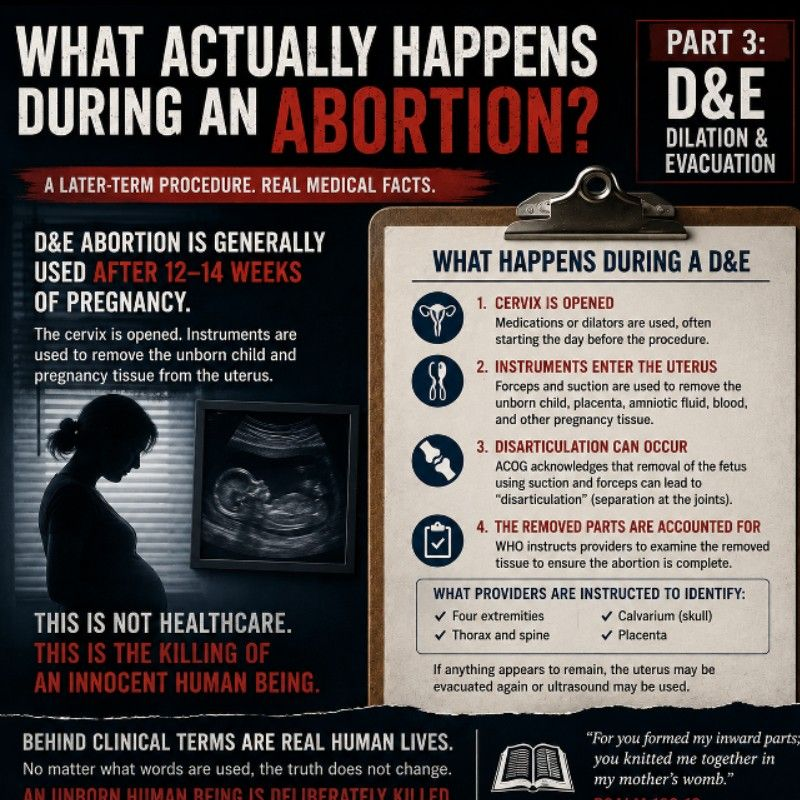
We examined dilation and evacuation (D&E).
We examined medical or induction abortion later in pregnancy.
Throughout this series, I deliberately relied heavily on organizations that support abortion access, including the American College of Obstetricians and Gynecologists (ACOG) and the World Health Organization (WHO).
Why?
Because I do not want you to take my word for it.
Read their descriptions.
Then decide what you believe.
Words Matter
Abortion has developed an entire clinical vocabulary.
Medication abortion.
Termination of pregnancy.
Products of conception.
Pregnancy tissue.
Uterine evacuation.
Vacuum aspiration.
Dilation and evacuation.
Disarticulation.
Every one of these terms has a medical meaning.
But medical terminology can sound very different from a plain-English description of the physical event.
That difference matters.
“Termination of Pregnancy”
This is perhaps the most basic description of abortion.
An abortion terminates a pregnancy.
Technically, that is true.
But what is a pregnancy?
Pregnancy is not an abstract condition floating around inside a woman's body.
During pregnancy, an embryo and later a fetus is developing inside the uterus.
So when an induced abortion terminates a pregnancy, it intentionally interrupts that prenatal development.
I believe the moral reality is even more direct:
The life of an unborn human being is deliberately ended.
“Products of Conception”
This may be one of the coldest terms encountered in this series.
Medical literature uses products of conception to describe pregnancy-related material within or removed from the uterus.
That can include placental and gestational tissue and embryonic or fetal tissue.
The term has legitimate medical uses, including in the treatment of miscarriage.
But consider how differently these sentences strike the human ear:
“The products of conception were removed.”
Compared with:
“The removed material included embryonic or fetal tissue.”
The first sounds almost industrial.
The second tells you more about what the words actually include.
“Pregnancy Tissue”
This term appeared repeatedly in the medical sources we examined.
And again, it is medically recognized terminology.
But what can pregnancy tissue include?
Placental tissue.
Gestational tissue.
And depending upon the stage and circumstances, embryonic or fetal tissue.
Calling all of it pregnancy tissue does not mean an embryo or fetus ceased to exist.
It describes a category of biological material.
“Uterine Evacuation”
Evacuation sounds almost harmless.
We evacuate buildings.
We evacuate people before hurricanes.
In abortion medicine, however, uterine evacuation refers to removing material from inside the uterus.
In Part 2, we saw that vacuum aspiration can accomplish this using suction.
In Part 3, we saw that D&E can involve suction and forceps.
The clinical phrase is uterine evacuation.
The important question is:
What is being evacuated?
“Disarticulation”
This was perhaps the most disturbing word in Part 3.
ACOG's own abortion-language material acknowledges that removal of the fetus during D&E using vacuum aspiration and forceps can result in disarticulation.
That word deserves translation.
An articulation is a joint.
Disarticulation means separation at a joint.
That is the medical word.
Readers may decide for themselves whether knowing its meaning changes how they understand the procedure.
The WHO Checklist Should Haunt Us
Perhaps nothing in this series affected me more than the World Health Organization's instructions concerning D&E.
WHO's clinical handbook tells providers to inspect the removed pregnancy tissue after the procedure.
Among the structures the provider is instructed to identify are:
- four extremities
- thorax and spine
- calvarium, meaning the skull
- placenta
Stop there.
Forget my opinion for a moment.
Forget politics.
Forget Republicans and Democrats.
Forget the words pro-life and pro-choice.
Ask yourself one question:
Why must someone account for four extremities, a chest, a spine and a skull?
Those structures belonged to a developing human organism.
Medical terminology does not change that biological fact.
Science and Morality Are Different Questions
There is another distinction we need to make.
Science can describe biological development.
Medicine can describe abortion procedures.
Ultrasound can show us what is developing inside the uterus.
None of those things, by themselves, answers every moral question.
The moral question is ours to confront:
What value does that developing human life have?
My answer is clear.
Human life has value because human beings are created by God.
David Had No Ultrasound
In Part 1, I pointed to something that still strikes me.
David lived roughly 3,000 years ago.
He had no ultrasound.
No modern embryology.
No fetal imaging.
Yet he wrote:
“For you formed my inward parts; you knitted me together in my mother's womb.”
Psalm 139:13.
David could not look through an ultrasound screen.
We can.
Modern technology gives us a window into prenatal development that previous generations could scarcely have imagined.
We should ask ourselves whether greater knowledge has produced greater moral responsibility.
And What About the Millstone?
Jesus issued a terrifying warning in Matthew 18:6 concerning anyone who causes one of His “little ones” to stumble.
As I explained in Part 1, the immediate context is not abortion, and I will not misuse Scripture by pretending otherwise.
But Christ's warning reveals something unmistakable about the seriousness with which He regards wrongdoing against His little ones.
That should matter to Christians.
It certainly matters to me.
What If You Don't Believe Any of This?
Perhaps you do not believe the Bible.
Perhaps you do not believe in Jesus Christ.
Perhaps you believe that when you die, everything simply ends.
I cannot force you to believe otherwise.
But I can ask you to consider the possibility that you are wrong.
If Christianity is true, then death is not the end.
There is a God.
Human beings bear enormous value before Him.
And every one of us will ultimately answer to Him.
So I ask the abortion supporter reading this:
What if you are wrong?
What if the life you dismiss as merely pregnancy tissue is exactly what Christians have been telling you it is: an innocent human life created by God?
If I am wrong about abortion, I spent my time defending human lives that I believed deserved protection.
But if you are wrong, the stakes are eternal.
If you are wrong about abortion, you will answer to God for it.
That is not a threat from me.
It is a warning based upon what I believe Scripture teaches about human life, sin, judgment and eternity.
Now You Know What the Words Mean
That was the purpose of this series.
Not photographs.
Not graphic shock tactics.
Not political slogans.
Information.
We looked at what the abortion drugs do.
We looked at suction aspiration.
We looked at forceps.
We looked at D&E.
We looked at induction.
We looked at what medical authorities themselves tell abortion providers to examine after certain procedures.
Now you know.
You may still support abortion.
You may reject every moral conclusion I have reached.
That is your decision.
But after reading this series, I hope one thing has become much harder:
Pretending you do not know what abortion physically involves.
I believe abortion deliberately destroys innocent human life.
I believe it is a grave moral evil.
And from my Christian worldview, I believe the deliberate destruction of innocent unborn human life is satanic to its core.
No euphemism will change that.
No medical terminology will change that.
No political slogan will change that.
The question is no longer simply what abortion is called.
The question is:
Now that you know what happens, what are you going to do with that knowledge?
Sources
American College of Obstetricians and Gynecologists (ACOG): Abortion Care. Clinical descriptions of medication abortion, vacuum aspiration, dilation and evacuation, and abortion terminology.
American College of Obstetricians and Gynecologists (ACOG): Guide to Language and Abortion. Discussion of abortion terminology, including D&E and disarticulation.
World Health Organization (WHO): Abortion Care Guideline, Second Edition. Recommendations concerning medical and procedural abortion at different gestational ages.
World Health Organization (WHO): Clinical Practice Handbook for Quality Abortion Care. Clinical descriptions of vacuum aspiration, D&E, medical abortion, and examination of pregnancy tissue following procedural abortion.
U.S. Food and Drug Administration (FDA): Questions and Answers on Mifepristone for Medical Termination of Pregnancy Through Ten Weeks Gestation. Information concerning mifepristone, progesterone and the FDA-approved mifepristone/misoprostol regimen.
Merck Manual Professional Edition: Clinical descriptions of medical and procedural abortion.
Latest Articles, Submissions & Community Highlights
Participating groups, neighborhood leaders, and citizen coalitions can share news, documents, or resources here.