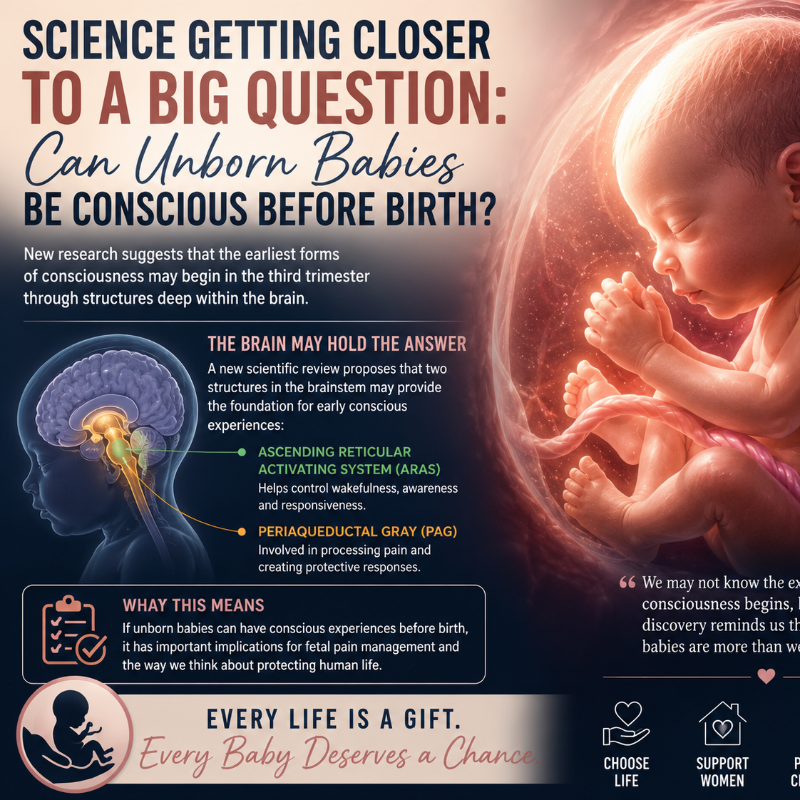
For years, many scientists believed that an unborn baby could not experience consciousness until the brain's outer layer, called the cerebral cortex, was fully developed late in pregnancy. But a newly published scientific review is challenging that long-held belief. Researchers now suggest that
the earliest forms of consciousness may begin during the third trimester, before birth, through structures deep within the brain known as the brainstem. The authors stress that this is
a hypothesis based on existing evidence, not proof, but they believe it deserves serious attention.
The new study proposes that consciousness may not begin with complex thinking or memory. Instead, it may begin with something much simpler—the ability to feel, respond to the world, and have basic subjective experiences. According to the researchers, two brainstem structures, the ascending reticular activating system (ARAS) and the periaqueductal gray (PAG), may provide the minimal brain architecture required for these early conscious experiences. Because these structures develop before the cerebral cortex is fully mature, the researchers suggest that an unborn baby may be capable of some level of conscious awareness during the third trimester. At the same time, they emphasize that scientists still cannot directly measure consciousness in an unborn child, so more research is needed.
If this hypothesis proves correct, it could have significant ethical implications. The researchers note that if unborn babies are capable of genuine conscious experiences before birth, medical professionals should carefully consider fetal pain management during surgeries and other procedures. The study does
not recommend changes to abortion laws, but it acknowledges that understanding when consciousness begins could influence future ethical and medical discussions.
For many people who oppose abortion, this research reinforces what they have believed for years: that unborn children are developing human beings deserving of care and protection. While science cannot yet identify the exact moment consciousness begins, each new discovery about fetal development reminds us how much remains unknown. Medical science continues to find that unborn babies respond to sound, touch, and other stimuli much earlier than many people once believed. As researchers continue to explore the mystery of consciousness, many believe society should respond with humility and caution rather than assuming that the unborn are incapable of meaningful experience.
The authors of the study are careful not to overstate their conclusions. They repeatedly explain that their work is an
evidence-based hypothesis, not a demonstration that fetal consciousness has been proven. Even so, the research adds another important piece to the growing body of scientific literature on prenatal development. It also reminds us that questions about human life are often more complex than political slogans or courtroom decisions.
The abortion debate is frequently framed around personal choice, legal rights, and public policy. But studies like this encourage a different question:
What if the unborn child is capable of more than we previously understood? While scientists continue to search for answers, many believe that the uncertainty itself should lead us to err on the side of protecting human life whenever possible. If there is a reasonable possibility that an unborn child can experience some form of consciousness before birth, that possibility deserves thoughtful consideration, not dismissal.
https://www.iflscience.com/at-what-point-does-a-developing-fetus-become-conscious-we-may-be-close-to-an-answer-83994?utm_source=chatgpt.com