Follow the Money - Who really benefits with all of the Kane County Tax Increases
Union political "donations" and who benefits from taxpayer-funded spending
Taxation with representation isn't working very well in Illinois. And Kane County taxpayers have every reason to ask why.
On November 3, 2026, St. Charles School District 303 voters rejected a $282.5 million bond referendum.
According to Kane County election results, 56.64% voted NO. The proposed borrowing was part of a $312.5 million facilities package. The taxpayers spoke, rejecting the proposal.
Yet the underlying question remains: Will school officials find alternative ways to finance some of these projects, including borrowing mechanisms that do not require another referendum? See article addressing this issue.
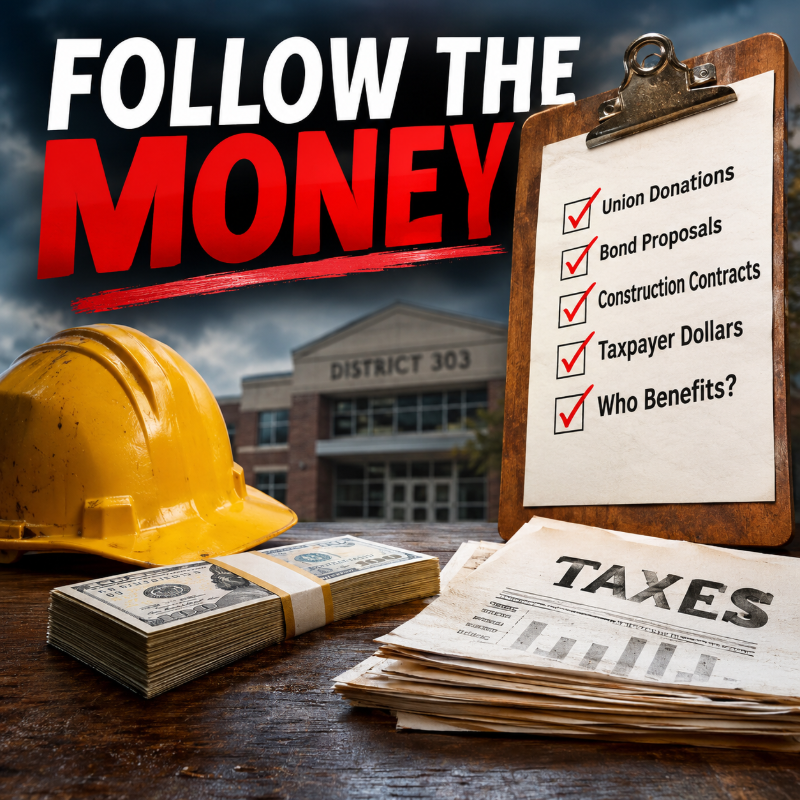
So...who actually benefits when government borrows and spends millions of your dollars?
Source: Kane County Election Results
FOLLOW THE POLITICAL MONEY
Public campaign-finance records reveal a continuing flow of contributions from organized labor to the Kane County Democratic Central Committee.
These organizations represent electricians, painters, laborers, firefighters, carpenters and other workers., representing industries that can benefit from public construction and infrastructure spending. The message is clear if the facts are read.
According to Transparency USA summaries, the following were among the reported contributions during the 2024 election cycle:
Organization Reported contributions:
- Painters & Allied Trades District Council #30 - $8,000
- IBEW Local 117 - $7,460
- LIUNA Chicago Laborers District Council-$6,000
- Elgin Association of Firefighters PAC- $5,830
- Mid-Central Illinois Regional Council of Carpenters PAC$5,150
- Total$32,440*
* These figures are based on the previously compiled Transparency USA summary and should be reconciled against individual state filings before being represeted as a final audited total.
They represent only a portion of the reported labor-related political contributions.
Source: Transparency USA — Kane County Democratic Central Committee
but let's look IN 2026
This isn't a story about the past. Illinois Sunshine records show that on May 13, 2026, seven labor-related organizations contributed a combined $5,700 to the Kane County Democratic Central Committee.
- IBEW Local 196 - $1,500
- IBEW Local 461 - $900
- Sheet Metal Workers Local 265 - $900
- Chicago Land Operators Joint Labor-Management PAC - $900AFT
- Local 604 COPE II - $600
- IBEW Local 364 Political Action Fund - $300
- IBEW Local 701 - $600
Total $5,700
These transactions are individually identified in public campaign-finance records. Source: Illinois Sunshine — May 13, 2026
Let's be clear.
There is nothing inherently illegal or improper about unions contributing to political campaigns.
Unions have every right to participate, but taxpayers have the right to know whether political relationships influence how their money is spent.
WHO GETS PAID?
Consider what happens when a school district undertakes a multimillion-dollar construction program.
Contractors receive payments.
Architects and engineers receive fees.
Financial advisers and bond professionals may receive compensation.
Bondholders receive interest.
Construction workers receive wages.
And when union contractors perform the work, union members and their organizations can benefit economically.
Some of these expenditures may be necessary and entirely appropriate.
But shouldn't taxpayers know who receives the money before government commits them to years of additional debt?
Shouldn't taxpayers know whether contractors or their principals have contributed to the political organizations supporting the officials responsible for public spending?
And shouldn't every major contract be subject to rigorous scrutiny?
The political contributions identified above went to the Kane County Democratic organization. They do not, by themselves, establish any connection to District 303 board decisions or construction contracts.
That distinction matters.
But so does transparency.
The burden shouldn't be on taxpayers to investigate after the money has already been spent, but that's today's reality.
THE VOTERS SAID NO. WHAT HAPPENS NEXT?
District 303's referendum failed.
The district had proposed borrowing $282.5 million for school repairs, accessibility improvements, classroom expansions and other facilities projects.
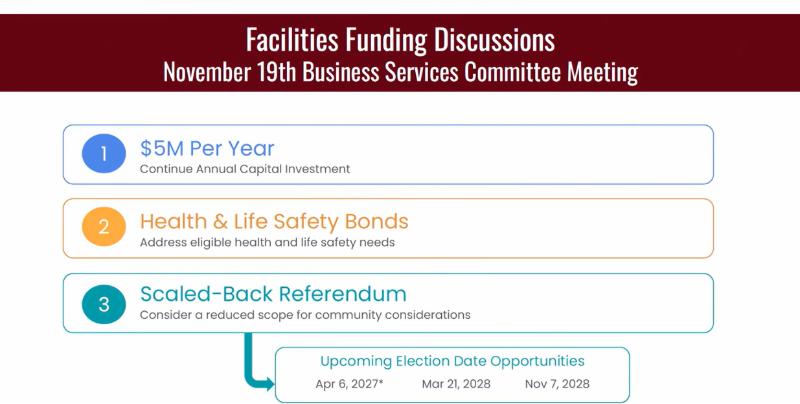
The school district has also discussed other financing options, including borrowing for qualifying Health and Life Safety projects.
Illinois law provides mechanisms for certain school safety-related improvements to be financed outside the ordinary referendum process, subject to statutory requirements.
That does not mean school districts can simply repackage every rejected construction project as a safety expense.
But it does raise an important accountability question.
If voters rejected the proposed borrowing, how much of that rejected spending should officials pursue through alternative financing?
Essential repairs and legitimate safety concerns must be addressed.
However, government officials should demonstrate necessity, disclose the financial consequences and respect the clear message voters delivered.
Source: District 303 Referendum Information
Source: Illinois Public Act 103-0591
FIVE QUESTIONS KANE COUNTY TAXPAYERS DESERVE ANSWERED
1. Who will receive the contracts?
Identify the contractors, consultants, architects, engineers and financial institutions that stand to receive taxpayer money.
2. What political connections exist?
Disclose relevant campaign contributions and financial relationships involving those seeking public contracts.
3. Was every contract competitively awarded?
Taxpayers deserve proof that price, qualifications and value determine the winners, not political relationships.
4. What will the borrowing actually cost?
Show the total principal, projected interest, financing fees and anticipated property-tax impact.
5. Why can't existing resources cover more of the work?
Before borrowing additional money, demonstrate that existing budgets, reserves and spending priorities have been thoroughly examined.
These are not radical demands. They are basic expectations of responsible government.
WHO IS REPRESENTING THE TAXPAYER?
Organized labor has political action committees.
Political parties have fundraising organizations.
Contractors have industry associations.
Government entities have lobbyists, consultants and financial advisers.
But who is speaking for the homeowner watching property taxes rise?
Who is representing the retired couple living on a fixed income?
Who is fighting for the young family struggling to afford its first home?
Who is protecting the small-business owner whose property-tax burden continues to grow?
These residents don't have the luxury of passing their expenses on to someone else.
They have to balance their budgets.
They have to make difficult decisions.
And when their expenses exceed their income, they cannot simply issue bonds and send someone else the bill.
No one is representing the voters if the voters have spoken and entities like D303 want to put a referendum back on the ballot. A victory through 'wearing out the taxpayer' is a criminal policy.
Why shouldn't government be held to the same standard?
TAXATION WITH REPRESENTATION MUST MEAN ACCOUNTABILITY
The issue is not whether unions should participate in politics.
The issue is not whether schools should be maintained.
Of course they should.
The issue is whether government is sufficiently accountable to the people who pay for it.
When political organizations receive substantial financial support from industries that can benefit from government spending, transparency becomes especially important.
Campaign contributions are not proof of corruption.
But they are a legitimate reason to examine financial relationships, public contracts and government decision-making.
And when voters reject a major borrowing proposal, officials should treat that decision as more than an inconvenience to overcome.
THE BOTTOM LINE - How about a policy that a union that donates can't have any contracts. They donate because the believe in the referendum, NOT BECAUSE what they gave will come back to them in spades.
The unions know how to organize.
Political committees know how to raise money.
Government entities know how to borrow.
Unions also know that it's in their best interest to donate to certain causes. Would unions donate if they we're going to get paid off in the long run? Ask yourself that question?
But who is organizing to protect the taxpayer?
In District 303, residents exercised their right to vote.
They rejected $282.5 million in proposed borrowing.
That vote deserves respect.
Before any additional debt is approved, taxpayers should demand complete disclosure of who benefits, what the projects cost, why the spending is necessary and whether less expensive alternatives exist.
Follow the money. Demand accountability. Respect the voters.
Because taxation with representation should never mean that the politically connected get heard while the taxpayers simply get the bill.
Sources: Illinois Sunshine, Transparency USA, Illinois State Board of Elections, Kane County Clerk, Illinois General Assembly and St. Charles Community Unit School District 303.
Latest Articles, Submissions & Community Highlights
Participating groups, neighborhood leaders, and citizen coalitions can share news, documents, or resources here.