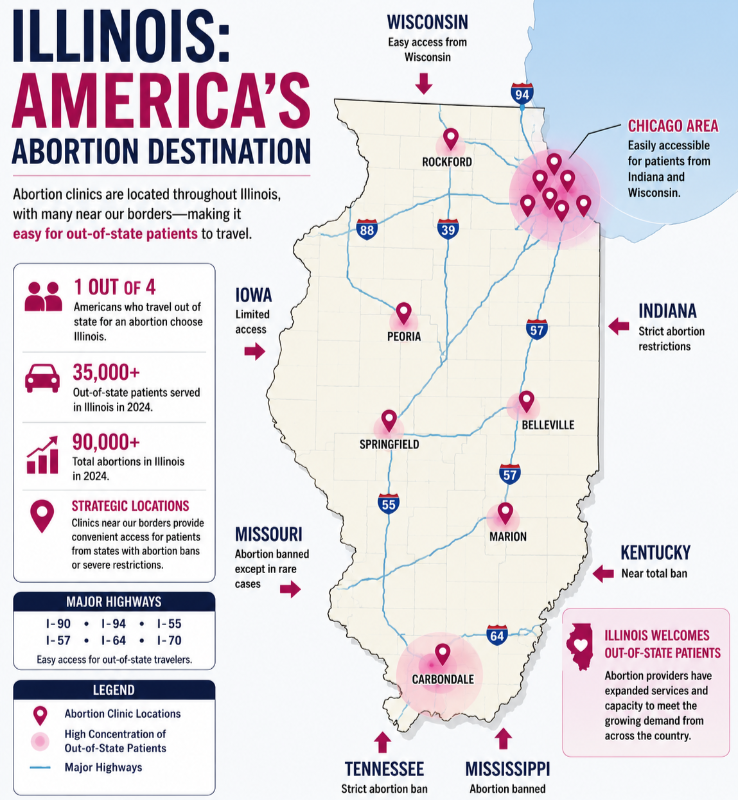
When the U.S. Supreme Court overturned Roe v. Wade in 2022, abortion laws changed dramatically across the country. While many states passed new restrictions, Illinois moved in the opposite direction. Today, Illinois has become the nation's leading destination for women traveling across state lines to obtain abortions. According to the Guttmacher Institute,
about 35,000 abortions performed in Illinois during 2024 were for women from other states, representing roughly
39% of all abortions performed in Illinois that year. Nearly
one out of every four Americans who crossed state lines for an abortion came to Illinois, more than any other state in the nation.
This did not happen by accident. Although the State of Illinois does not own or operate abortion clinics, abortion providers have openly expanded services to meet the growing demand from out-of-state patients. Clinics have hired additional doctors and nurses, enlarged their facilities, increased appointment availability, and expanded telehealth services to serve the rising number of women traveling to Illinois. One of the state's largest abortion providers reported expanding its staff from about 40 employees to more than 70 after the Dobbs decision while also significantly increasing its clinic space.
Geography has also played an important role. Several abortion providers have expanded in locations that are convenient for women traveling from neighboring states. Southern Illinois, especially the Carbondale area, has become a major destination because it is within driving distance of Kentucky, Tennessee, Missouri, Mississippi, and other states with more restrictive abortion laws. One provider specifically announced that it chose Carbondale because of its location and described the clinic as a "lifeline" for patients traveling from the Southeast. Research has also found that a large independent abortion clinic located near the Missouri border serves a majority of patients who live outside Illinois.
Governor J.B. Pritzker has repeatedly said that Illinois should remain a place where women from other states can obtain abortions. His administration has signed legislation expanding legal protections for abortion providers and out-of-state patients, while Illinois lawmakers have passed laws designed to shield providers from legal action by other states. Supporters argue these laws protect access to reproductive healthcare. Opponents believe they have encouraged Illinois to become a regional abortion destination and have increased the number of abortions performed in the state.
For many people, these developments are deeply troubling. Every woman who travels to Illinois represents someone facing a difficult and often frightening situation. Every abortion also represents an unborn child whose life has ended. Rather than investing more resources into making abortion easier to obtain, many believe Illinois should focus on expanding support for pregnant women through adoption services, pregnancy resource centers, housing assistance, counseling, medical care, and community programs that help mothers choose life.
The numbers tell a remarkable story. Illinois has gone from performing just over
46,000 abortions in 2020 to an estimated
more than 90,000 in 2024. Much of that increase has come from women traveling from other states. The question now is not whether Illinois has become America's abortion destination—the data clearly show that it has. The larger question is whether this is the role Illinois should play. Supporters see the state as a refuge for women seeking abortion care. Critics see a state that has become a magnet for ending unborn lives. That debate is likely to continue for years to come, but one fact remains unchanged: behind every statistic is a woman facing a difficult decision and, many believe, a child who will never have the opportunity to be born.
https://dph.illinois.gov/data-statistics/vital-statistics/abortion-statistics.html?utm_source=chatgpt.com
https://dph.illinois.gov/data-statistics/vital-statistics/abortion-statistics/abortion-statistics-archive.html?utm_source=chatgpt.com
https://www.guttmacher.org/news-release/2025/guttmacher-institute-releases-data-state-residence-us-abortion-patients-traveling
https://www.nprillinois.org/illinois/2025-04-18/nearly-1-in-4-out-of-state-abortion-patients-come-to-illinois-new-report-finds
https://www.ilga.gov/legislation/publicacts/fulltext.asp?Name=102-0685
https://www.plannedparenthood.org/planned-parenthood-illinois/patient-resources/whether-youre-in-illinois-or-from-another-state