
What Actually Happens During an Abortion? PART 3
Part 3: Dilation and Evacuation
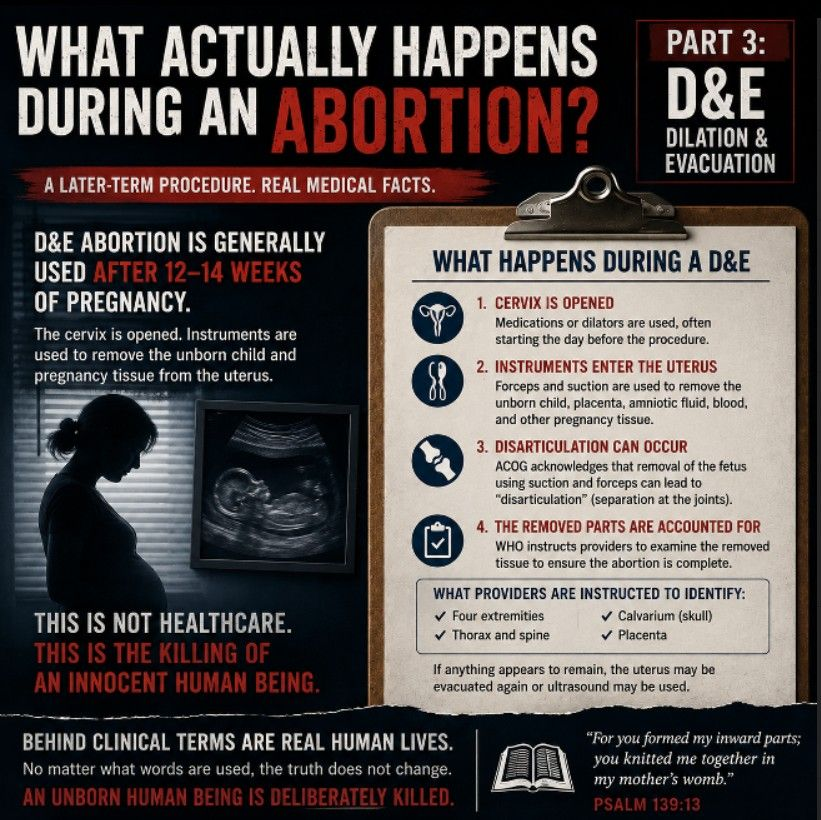
Parts 1 and 2 of this series examined the abortion pill and suction aspiration. Part 3 is more difficult.
This procedure is called dilation and evacuation (D&E). It is generally used later in pregnancy than the procedures discussed previously.
I am going to describe what happens in plain English. I am not going to exaggerate it. I do not need to.
The medical authorities that support abortion access describe enough themselves.
What Is a D&E Abortion?
The American College of Obstetricians and Gynecologists (ACOG) says most procedural abortions during the second trimester are performed using dilation and evacuation. The World Health Organization (WHO) describes D&E as a surgical abortion technique used after approximately 12 to 14 weeks of pregnancy where trained and experienced practitioners are available. At this stage, the unborn human being is larger and more developed than during the earliest weeks of pregnancy.
That changes how the abortion is performed. This is no longer simply a matter of inserting a small suction tube and emptying the uterus. Forceps and other instruments may now be used.
Step One: The Cervix Is Opened
The first word in D&E is dilation. That means opening the cervix. Because the pregnancy is farther along, the cervix generally needs preparation before the abortion. ACOG explains that medications or dilators, which are rods placed into the cervix, can be used. Sometimes cervical dilation begins the day before the procedure. WHO likewise says cervical preparation is required and may involve osmotic dilators, medications, or both. Once the cervix has opened sufficiently, the abortion can proceed.
Step Two: Suction and Instruments Enter the Uterus
Now comes the evacuation. ACOG describes it this way: a suction device and instruments are used to remove the pregnancy. WHO provides considerably more detail. Its clinical handbook states that D&E evacuates the uterus primarily with forceps, while vacuum aspiration is used to remove remaining blood or tissue. Forceps are grasping instruments. Put this into plain English. The cervix has been opened. Instruments are passed through it and into the uterus. The abortion provider uses suction and forceps to remove the unborn human being, placenta, amniotic fluid, blood and other pregnancy tissue from the uterus.
What Happens to the Unborn Human Being?
This is where the language becomes uncomfortable. It should. Even ACOG's own abortion-language guidance acknowledges that during D&E, removal of the fetus using vacuum aspiration and forceps can lead to what medicine calls “disarticulation.” What does disarticulation mean? It means separation at the joints. In ordinary English, parts of the fetal body may become separated during removal. ACOG objects to describing the procedure as “dismemberment” because it considers that word inflammatory. Readers can decide for themselves which word they believe most clearly describes the physical reality. But the underlying fact is not merely rhetoric from the pro-life movement.
ACOG itself acknowledges that the fetus may be disarticulated during D&E.
Step Three: The Removed Parts Are Accounted For
Perhaps the most disturbing description comes not from a pro-life organization, but from the World Health Organization's clinical instructions. After evacuation, WHO instructs the provider to examine the removed pregnancy tissue to make sure the abortion is complete. What must be identified?
WHO specifically lists:
- four extremities
- thorax and spine
- calvarium, meaning the skull
- placenta
Read that list again.
Four extremities.
Chest and spine.
Skull.
Placenta.
Why would a medical handbook instruct the provider to identify those structures? Because the provider needs to make sure the uterus has been completely evacuated. If examination suggests that something remains inside, WHO says the uterus may need to be evacuated again or ultrasound may be used to confirm completion. This is the clinical reality hidden inside phrases such as evacuation of pregnancy tissue.
This Is Why Words Matter
Consider the difference between these two descriptions:
“The contents of the uterus are evacuated.” And: Forceps and suction are used to remove the fetus, and afterward the removed tissue is examined to identify the extremities, chest and spine, skull and placenta. Both descriptions concern the same procedure. One tells you almost nothing about what physically happened. The other forces you to understand it. That is precisely why I am writing this series.
Am I Using Inflammatory Language?
Critics may accuse me of doing exactly that. So don't take my word for it. Read the medical sources.
ACOG says D&E involves suction and instruments. ACOG acknowledges that removing the fetus using suction and forceps can result in disarticulation. WHO says D&E primarily uses forceps. WHO instructs providers afterward to identify the extremities, thorax and spine, skull and placenta. These o organizations support legal abortion access. I do not. But on these physical facts, we do not need to agree morally to understand what their own medical documents describe.
What Do I Call It?
I believe an unborn child is a human being created in the image of God. At this stage of pregnancy, that human being has not somehow become less valuable because medical terminology has become more complicated. So when instruments enter the uterus, when forceps grasp the fetus, when the body can be separated at its joints, and when the provider afterward accounts for the extremities, spine and skull, I refuse to pretend that the central moral fact has disappeared. An unborn human being has been deliberately killed. You may call the procedure dilation and evacuation. You may call what happens to the fetal body disarticulation. I call the deliberate destruction of that unborn human life what I believe it is: The killing of an innocent human being.
Sources
American College of Obstetricians and Gynecologists (ACOG): Abortion Care. ACOG explains that most second-trimester procedural abortions use dilation and evacuation and describes cervical dilation followed by suction and instruments to remove the pregnancy.
American College of Obstetricians and Gynecologists (ACOG): Guide to Language and Abortion. ACOG states that D&E after roughly 12 to 15 weeks involves removing the fetus using vacuum aspiration and forceps and acknowledges that this can lead to disarticulation.
World Health Organization (WHO): Clinical Practice Handbook for Quality Abortion Care. WHO describes D&E after approximately 12 to 14 weeks as involving cervical preparation, forceps and vacuum aspiration. Its clinical instructions also describe inspection of the removed pregnancy tissue to confirm completeness.
Merck Manual Professional Edition: Procedural and Medical Abortion. Merck describes procedures at 14 weeks and later as requiring cervical dilation and forceps to evacuate pregnancy tissue.
https://www.acog.org/womens-health/faqs/induced-abortion?utm_source
https://www.acog.org/contact/media-center/abortion-language-guide?utm_source
https://www.who.int/publications/i/item/9789240075207?utm_source
Next: Part 4, Induction Abortion. What happens when medications are used later in pregnancy to cause the uterus to contract and expel the pregnancy?
Latest Articles, Submissions & Community Highlights
Participating groups, neighborhood leaders, and citizen coalitions can share news, documents, or resources here.