
Why Feminists Love Criminals
lindsay clancy exposes the feminist problem
Opinion submission by Cornell Overbeeke, MD, MS
There is an ancient moral question that every civilization must answer:
What do we owe the victim?
For most of Western history, answering that question required identifying an act before identifying a class. A murder was judged as a murder, theft as theft, cruelty as cruelty. Circumstances mattered. Motive mattered. Mental capacity mattered. Mercy mattered. But the moral inquiry began with something concrete:
What happened? Who did it? To whom was it done?
Modern feminism approaches the matter differently. It begins not primarily with the act but with the distribution of power surrounding the act. Who is privileged? Who is marginalized? Who possesses institutional authority? Who belongs to a historically subordinated group? What structures produced the person who stands before us?
These are not foolish questions. Frequently they are indispensable ones.
But when they become the first questions, and especially when they become the questions through which all others must be interpreted, something peculiar happens. A person who belongs to an oppressed category can retain the moral aura of victimhood even while becoming a perpetrator. The actual victim—sometimes vastly weaker than the person who harmed him—can begin quietly disappearing from view.
The extraordinary public reaction surrounding the 2026 murder trial of Lindsay Clancy provides an almost laboratory-perfect example of the phenomenon.
Clancy does not deny killing her three children, five-year-old Cora, three-year-old Dawson and eight-month-old Callan, in January 2023. The legal question before the Massachusetts jury is whether she possessed criminal responsibility when she did so.
Her defense argues that severe postpartum psychiatric illness, including psychosis, deprived her of that responsibility; prosecutors argue that although she was mentally ill, she nevertheless understood what she was doing and that it was wrong. Experts have offered sharply conflicting psychiatric assessments. As of August 28, 2026, the jury has completed two days of deliberations without a verdict.
That legal question is grave, difficult and legitimate. Postpartum psychosis is real. It is rare, potentially catastrophic and a genuine psychiatric emergency. A civilized legal system must distinguish between a person who deliberately murders and one whose capacity for criminal responsibility has genuinely been destroyed by mental disease.
Compassion is not an enemy of justice when compassion insists upon examining the truth.
Yet outside the courtroom, something different has been unfolding.
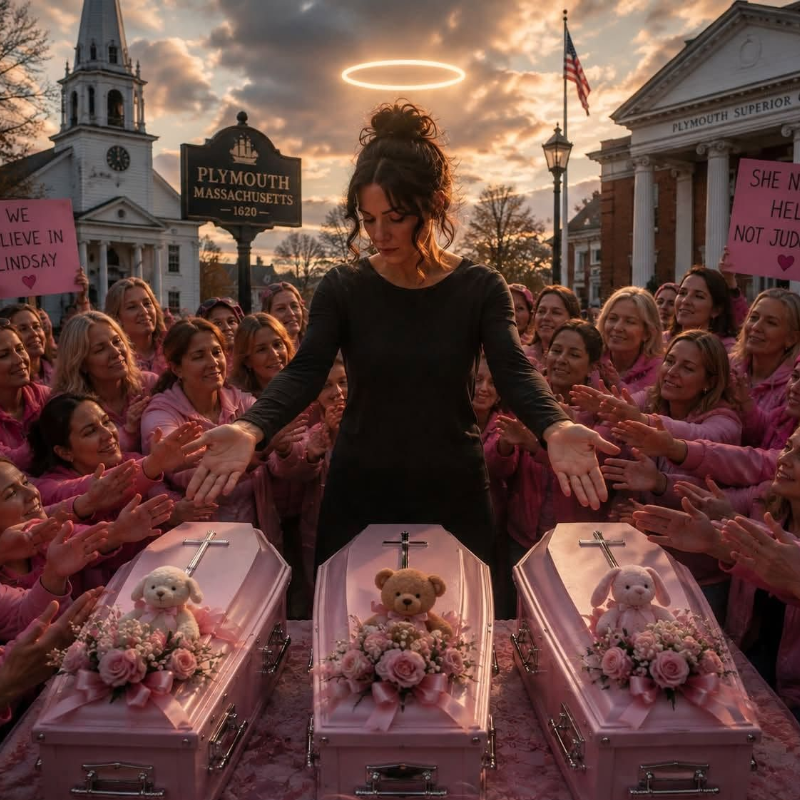
More than 400 supporters, most of them women and many dressed in pink, gathered outside Plymouth Superior Court in a demonstration called “Stand in Peace for Lindsay.” Some women described identifying personally with Clancy because of their own experiences with postpartum depression, anxiety or other mental-health crises. One supporter explicitly said she “resonated with Lindsay herself.”
Supporters have organized events beyond Massachusetts, and a fundraiser for Clancy’s parents surpassed $1 million.
Many of these women insist—and there is no reason automatically to disbelieve them—that they have not forgotten the children. One woman outside the courthouse specifically told the Boston Globe that supporting Clancy did not mean forgetting Cora, Dawson and Callan.
Nevertheless, the symbolism is difficult to miss.
Three children were killed.
The public demonstrations are for their killer.
To understand how such an inversion becomes psychologically and philosophically possible, one must go considerably further back than contemporary feminism.
From Sin to Structure
The intellectual genealogy is not a straight line, and it would be historically careless to pretend that Marx begat Foucault who begat feminism in some simple succession. Modern feminism contains liberal, radical, socialist, poststructuralist and other traditions that often disagree bitterly with one another.
But the power-centered strand of contemporary feminism emerged from a convergence of several powerful intellectual currents.
Marx supplied the analysis of structural domination.
In traditional moral reasoning, exploitation was ordinarily something one person did to another. Marx taught generations of subsequent thinkers to look beneath individual transactions and examine the structure itself.
A worker might appear voluntarily to sell his labor to an employer, yet Marx argued that the economic arrangement could nevertheless embody exploitation because ownership and class determined the terms on which the transaction occurred.
The great conceptual innovation was that injustice could reside in a system even when no individual actor consciously intended it.
Second-wave socialist feminists adapted this insight. Marx, they argued, had seen class domination but overlooked gender domination. His analysis therefore had to be supplemented by an account of patriarchy, reproductive labor and the subordination of women.
Feminist theories explicitly joined Marxian class analysis to the analysis of male power.
This was an enormously consequential development.
Once oppression becomes structural, the morally significant question is no longer merely:
Who injured whom?
It becomes:
Where does each person stand within the system?
Nietzsche supplied another instrument: suspicion.
Nietzsche was hardly a proto-feminist. But his genealogical method helped transform Western intellectual life.
Moral concepts could themselves be investigated historically and psychologically. One need not accept society’s declaration that some institution was virtuous; one could ask what drives produced the morality, whose interests it served and what concealed struggles lurked beneath apparently noble language.
The question subtly changed from:
“Is this moral claim true?”
to:
“What lies behind this moral claim?”
That habit of suspicion would become one of the defining intellectual gestures of the twentieth century.
Then came Michel Foucault, whose importance is difficult to exaggerate.
Foucault expanded power far beyond the state, the police or the capitalist.
Power circulated through institutions, professional expertise, medicine, psychiatry, prisons, sexuality, education, language and definitions of normality itself. Power did not merely prohibit; it classified, normalized and even helped produce the categories through which human beings understood themselves.
Feminist theory found these concepts immensely productive. Feminists came to conceptualize power variously as a resource, domination and empowerment.
Finally came the enormous expansion of intersectionality.
Kimberlé Crenshaw’s original legal insight was both specific and important. Antidiscrimination law could fail black women because their experience could not always be decomposed neatly into discrimination against black people generally or women generally.
Intersectionality subsequently developed into a much broader intellectual framework concerning overlapping systems of oppression and positions within hierarchies of power and privilege.
Thus emerged a powerful interpretative machinery:
Class.
Race.
Sex.
Sexuality.
Institution.
Privilege.
Marginalization.
Oppressor.
Oppressed.
It became possible to take almost any human relationship and ask not merely what occurred within it, but how the surrounding architecture of power determined its meaning.
And sometimes that reveals something that ordinary moral vision misses.
But every intellectual instrument carries the temptation to mistake itself for the whole toolbox.
When Explanation Devours Responsibility
The danger begins with an entirely reasonable proposition:
Human beings are influenced by circumstances they did not choose.
Poverty matters. Trauma matters. Psychiatric illness matters. Childhood matters. Discrimination matters. Social institutions matter.
From there comes another reasonable proposition:
Understanding these circumstances may change our assessment of responsibility.
The difficulty appears in the nearly imperceptible passage from those propositions to a third:
Because we can explain an offender through forces acting upon her, she should herself be understood primarily as a victim of those forces.
At that moment, causal explanation begins consuming moral agency.
One sees versions of this reasoning in contemporary arguments about crime. The offender’s violence is relocated into childhood trauma, poverty, addiction, racism, inadequate education or social exclusion.
Again, every one of these factors may genuinely contribute to crime.
The error consists not in mentioning them but in permitting their causal significance to swallow the agency of the person who acted.
The grammatical subject quietly changes.
A man no longer simply robbed someone.
He was failed by society and became involved in robbery.
A violent offender was produced by structural conditions.
The linguistic transformation is small but philosophically immense.
The perpetrator becomes increasingly passive in the description of his own act.
Meanwhile his victim, who may have been poor, traumatized and marginalized too, strangely receives much less sociological explanation.
This is the paradox of power-centered morality:
It may sympathize most intensely with the person whose social category has been designated vulnerable rather than with the individual who was actually most vulnerable at the moment of the act.
The Privilege of Victimhood
Victimhood, within such a system, can acquire a peculiar moral property.
It becomes transferable.
A person who has suffered oppression carries the moral significance of that oppression into circumstances in which she herself possesses overwhelming power.
This is precisely where the categories begin breaking down.
A woman may be less powerful than an employer.
She may be less powerful than a hospital.
She may have been failed by psychiatrists.
She may inhabit a society containing genuine disadvantages associated with sex and motherhood.
All of those propositions could be true.
And she may simultaneously possess almost godlike power over an eight-month-old infant.
The oppressor/oppressed model becomes unstable because power is relational rather than permanent.
Nobody is simply “powerful” or “powerless.”
A billionaire standing before a judge can be powerless.
A prison guard of modest income can possess extraordinary power over a wealthy prisoner.
A physician possesses authority over a patient in one context and becomes helpless when lying anesthetized on another physician’s operating table.
A mother may experience profound vulnerability in the healthcare system and nevertheless remain incomparably stronger than the three small children sleeping in her home.
If one’s morality assigns identities before examining relationships, however, the designation oppressed can follow a person from one context into another like a kind of moral diplomatic immunity.
The oppressed person becomes difficult to perceive as oppressor.
And so one arrives at the strange spectacle of public sympathy concentrating upon the mother who killed while the children she killed hover increasingly at the edge of the picture.
This need not mean Clancy was criminally responsible. That remains the jury’s question.
It means something different.
Even if Lindsay Clancy was legally insane, Cora, Dawson and Callan were still the primary victims of what happened in that house.
Psychosis may alter culpability.
It cannot reverse victimhood.
Foucault’s Missing Tribunal
The deepest weakness in power-centered morality was recognized long ago by feminists themselves.
Nancy Fraser famously criticized Foucault’s theory as “normatively confused.” If ideas such as legitimacy, autonomy and normality are themselves entangled with power, Fraser asked, upon what independent basis can we condemn one operation of power while praising resistance to it?
If power is everywhere, why is resistance morally superior to domination?
Fraser’s objection is that without normative principles external to the analysis of power, Foucault has difficulty explaining why domination ought to be resisted at all.
Other feminist thinkers similarly worried that treating the individual subject primarily as an effect of power undermined the concept of agency that an emancipatory politics requires.
This is not a minor technical objection.
It is the central philosophical problem.
Power can tell us who can compel whom.
It cannot tell us whether the compulsion is just.
A policeman possesses more immediate coercive power than a murderer he arrests. That does not make the murderer morally superior.
A parent possesses enormous power over a toddler. That does not make parenthood oppressive.
A surgeon possesses extraordinary power over an unconscious patient. That power may constitute benevolent stewardship rather than domination.
Conversely, a physically weak person can lie, manipulate, betray or abuse someone stronger.
Power is morally significant.
But power is not morality.
The moment power becomes the principal moral category, one needs some further criterion by which benevolent power is distinguished from tyranny, legitimate authority from domination, protection from persecution and justice from revenge.
And the moment one introduces such a criterion, one has implicitly admitted that morality rests upon something deeper than power.
The Revolution That Cannot End
There is an even more serious contradiction.
Suppose we grant the most radical version of the oppressor/oppressed worldview everything it demands.
Let the revolution succeed completely.
Dismantle every existing hierarchy.
Confiscate inherited wealth.
Remove institutional discrimination.
Equalize educational expenditure.
Equalize political representation.
Abolish traditional status systems.
Begin again.
What happens the following morning?
Human inequality recurs immediately.
One child is more intelligent than another.
One is stronger.
One is healthier.
One has greater charm.
One possesses unusual musical gifts.
Another has dyslexia.
One is born beautiful.
Another becomes chronically ill.
One has disciplined parents.
Another has chaotic parents.
One is naturally conscientious.
Another is impulsive.
One makes friends effortlessly.
Another spends adolescence alone.
These differences exist before capitalism, before patriarchy and before politics.
Nature itself is radically unequal.
Even if every citizen received exactly $100,000 at noon on Monday, by Friday their holdings would differ.
Some would spend, others invest. Some would gamble, others save. One would become ill. Another would invent something valuable. Another would marry wealth. Another would have six children.
To restore equality, someone would have to intervene.
And here the final irony appears.
Perfect equality would require extraordinary inequality of power.
Someone must measure the disparities.
Someone must decide which disparities are unjust.
Someone must calculate compensation.
Someone must seize resources from one person and give them to another.
Someone must prevent new inequalities from arising.
The society most fanatically committed to abolishing hierarchy would therefore require a class of administrators possessing unprecedented authority over everyone else.
The egalitarian project recreates hierarchy at the very moment it abolishes it.
The revolution acquires guardians.
The guardians acquire offices.
The offices acquire privileges.
The revolution that began by condemning power ends by concentrating it.
The old rulers are gone.
The ruling remains.
Equality That Feeds Upon Itself
Alexis de Tocqueville perceived another paradox almost two centuries ago.
As societies become more equal, the remaining inequalities may become more psychologically irritating, not less. When enormous inherited distinctions are ordinary, people may scarcely notice many of them. But as those distinctions disappear, comparatively small differences become increasingly visible.
The appetite for equality can therefore grow by feeding upon its own success.
This matters enormously for an ideology whose evidence of oppression consists substantially in disparities.
Suppose women are legally prohibited from voting.
The grievance has a clear remedy:
Give women the vote.
Victory can be declared.
Suppose a university refuses to admit women.
Admit them.
Again, the injustice possesses a stopping condition.
But now imagine a different proposition:
Whenever two demographic groups achieve different average outcomes, the disparity itself constitutes evidence of structural oppression.
The grievance may no longer possess an endpoint.
If income differs, investigate oppression.
If income equalizes but occupational representation differs, investigate oppression.
If representation equalizes but executive leadership differs, investigate oppression.
If leadership equalizes but subjective experiences of belonging differ, investigate oppression.
If measurable conduct equalizes but unconscious attitudes remain, investigate oppression.
If attitudes improve but language retains historical associations, investigate oppression.
The object of reform retreats indefinitely.
There will always be another disparity because human beings are not interchangeable units.
And therefore there will always be another structure to interrogate.
An ideology originally created to remedy injustice becomes incapable of recognizing justice because its diagnostic instrument requires pathology to remain meaningful.
The successful revolution is consequently not its culmination.
It is an existential threat.
A movement whose organizing identity is resistance to oppression cannot easily announce that oppression has substantially ended. Victory would dissolve the moral drama that sustains the movement.
So oppression must migrate.
From law to institution.
From institution to culture.
From culture to language.
From language to psychology.
From conscious psychology to unconscious bias.
The territory becomes progressively less visible precisely as the theory becomes more certain of its presence.
The Child at the Bottom of the Hierarchy
And so we return to Plymouth, Massachusetts.
There is something almost unbearably revealing about the Lindsay Clancy case because it collapses abstractions into a single household.
One can construct an elaborate structural account of Lindsay Clancy.
She was a woman.
A mother.
A psychiatric patient.
Someone experiencing profound mental distress.
Possibly someone badly served by a fragmented medical system.
Perhaps—depending upon what the jury concludes—someone so psychotic that ordinary criminal responsibility cannot fairly be attributed to her.
Every one of those considerations belongs in a humane moral account.
But then there were three other people.
Cora.
Dawson.
Callan.
They possessed no institutional power.
No economic power.
No political voice.
No medical authority.
No ability to leave the household.
No meaningful ability to protect themselves.
Their world consisted largely of the adults upon whom they depended.
If morality is genuinely about defending the powerless, then the moral analysis ultimately arrives there.
At the nursery door.
Whatever injustices may have been done to their mother, there was no one in that house more powerless than the children.
That is the contradiction which the oppressor/oppressed imagination has enormous difficulty resolving. It understands vertical social categories more readily than shifting human relationships.
It knows how to recognize the oppressed woman confronting the powerful institution.
It becomes strangely disoriented when the oppressed woman turns around and encounters someone smaller than herself.
The theory then faces a choice.
It can preserve the category.
Or it can preserve the victim.
A morally serious feminism should choose the victim.
Indeed, many feminists do.
But the strain of feminism that has absorbed the deepest assumptions of power-centered politics risks doing something more troubling. It can transform sympathy into exculpation, explanation into innocence and historical disadvantage into a kind of transferable moral credit.
That is not compassion.
It is category error.
Beyond Oppressor and Oppressed
A mature civilization requires a richer moral vocabulary.
It needs justice and mercy.
Agency and circumstance.
Rights and responsibilities.
Authority and restraint.
Guilt and mitigation.
Compassion for the offender and loyalty to the victim.
It must be capable of saying simultaneously:
A person was terribly harmed.
And that person later harmed someone else.
A society failed her.
And she may still bear responsibility.
Mental illness can diminish culpability.
And the people she killed remain victims.
Power matters.
And power alone cannot tell us what is right.
There is wisdom in the older Western conviction that human beings possess equal dignity without possessing equal condition.
Those propositions are not contradictory.
The newborn child and the President do not possess equal power. They nevertheless possess equal human worth.
The student and professor do not possess equal knowledge.
The patient and physician do not possess equal expertise.
The defendant and judge do not possess equal authority.
Justice does not require pretending these inequalities do not exist.
It requires determining what obligations accompany them.
The proper political question is therefore not:
How can hierarchy finally be abolished?
It cannot.
The proper questions are:
Which hierarchies are legitimate?
Which are corrupt?
How should power be restrained?
What duties are owed by the strong to the weak?
How do we preserve the dignity of those who lose the competitions nature and society inevitably create?
The American constitutional tradition approached the problem with greater sobriety than utopian politics. Madison did not imagine that ambition would disappear after enlightened reform. He assumed ambition was permanent and therefore sought to make power counteract power.
The constitutional system attempted not to abolish human nature but to build institutions capable of surviving it.
That is a less exhilarating vision than liberation without remainder.
It is also more compatible with everything we know about mankind.
There will never be a morning after the revolution when power has vanished.
There will never be a society without stronger and weaker, fortunate and unfortunate, admired and forgotten, healthy and sick, gifted and ordinary.
Biology alone guarantees inequality before politics ever enters the room.
And consequently an ideology that defines injustice by the continued existence of unequal power can never, even in principle, discover the world it seeks.
Its grievance possesses no natural terminus.
Every hierarchy abolished exposes another.
Every disparity corrected reveals a smaller disparity beneath it.
Every liberation creates new authorities empowered to administer liberation.
Every revolution produces its custodians.
And eventually the pursuit of a world without power can demand almost unlimited power over the world.
That is the final paradox.
A philosophy born from compassion for the victim can become so preoccupied with identifying structures of oppression that it loses sight of actual victims.
A philosophy intended to emancipate the powerless can excuse power when exercised by someone carrying the approved identity of powerlessness.
And a philosophy dedicated to abolishing hierarchy can require an ever more formidable hierarchy to complete an impossible task.
The tragedy of Lindsay Clancy should therefore invite something more serious than another political slogan.
Perhaps she was criminally responsible.
Perhaps she was not.
The jury must answer that according to evidence and Massachusetts law.
But philosophy must answer another question.
When our theories tell us whom to pity before we have even looked to see who lies wounded at their feet, perhaps it is the theory—not reality—that has been turned upside down.
For beneath every abstraction about systems, identities and structures there remains an older and simpler moral reality:
Someone can suffer and still do evil.
Someone can be oppressed and still oppress.
Someone can be powerless before one person and terrifyingly powerful before another.
And justice begins when we are willing to see all three at once.
Latest Articles, Submissions & Community Highlights
Participating groups, neighborhood leaders, and citizen coalitions can share news, documents, or resources here.