
Illinois Taxpayers Fund Abortion and Gender Mutilation
how much? The State DoesN't want you to know
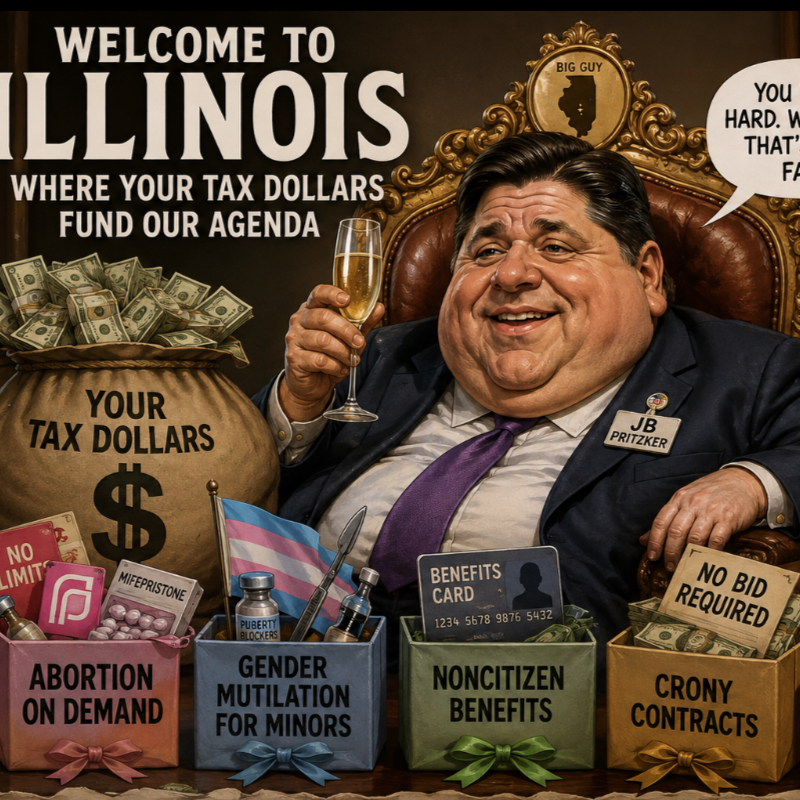
Abortion deliberately ends the life of an unborn human being. Illinois public funds support abortion procedures, abortion-provider programs, abortion-access infrastructure, and programs designed to expand what the state calls "gender-affirming care." In this article, I use the term gender mutilation when referring specifically to irreversible surgeries that alter sex characteristics. The underlying programs, payment policies, and funding figures discussed below come from Illinois government records.
What is surprisingly difficult to determine is the complete price tag. Illinois does not appear to provide taxpayers with one simple annual accounting showing exactly how much public money is spent on abortion and gender-transition procedures. So I started digging through Illinois Department of Healthcare and Family Services (HFS) notices, state grant databases, appropriations, and other public records. What I found raises serious questions about both spending priorities and transparency.
Illinois Taxpayers Pay for Medicaid Abortions
In 2017, Illinois passed House Bill 40. Among other changes, the law removed restrictions that had prevented state Medicaid funding from being used for most abortions. At the time, the Illinois Department of Healthcare and Family Services estimated that the change would cost taxpayers approximately $1.8 million per year for abortion services. According to the state's fiscal note, that money would be 100 percent funded through the state's General Revenue Fund.
That $1.8 million figure is important, but it should not be presented as the amount Illinois is spending today. It was an estimate made when HB 40 was being considered nearly a decade ago. By 2022, Illinois was substantially increasing what Medicaid paid for abortion services. Governor JB Pritzker announced a 20 percent increase in Illinois Medicaid reimbursement rates for abortion services. The Governor's announcement estimated that the increase itself would cost approximately $3 million annually. That figure should not be confused with the state's total annual spending on abortion services.
HFS's published 2022 abortion-rate notice set reimbursement at $792 for an induced abortion by dilation and curettage, $1,920 for an induced abortion by dilation and evacuation, and $558 for medication-abortion services, excluding the abortion drugs themselves.
Even more importantly, HFS states that abortion claims are billed directly to the department, including abortions involving Medicaid recipients enrolled in managed-care plans. HFS has also stated that abortion services for fee-for-service and managed-care customers are state-only funded.
In May 2026, HFS issued new billing guidance confirming that mifepristone and misoprostol continue to be covered by Illinois Medicaid without prior authorization for medication abortion.
The taxpayer support does not necessarily end when the abortion procedure ends. Illinois Medicaid also reimburses certified doulas for support "during or after miscarriage or abortion." HFS created billing code T1032 for that service. A December 2024 HFS fee schedule listed reimbursement at $15 for each 15-minute unit, and HFS confirmed in May 2026 that the benefit remains available, with a daily limit of two hours. The 2026 guidance applies to Medicaid customers in both fee-for-service and HealthChoice Illinois managed-care plans.
This matters because the public cost of Illinois abortion policy cannot be measured only by looking at the reimbursement for the abortion itself. Depending on the case, taxpayer-supported services can also include medication, related medical services, and post-abortion support. Each category needs to be identified and counted before taxpayers can know the true total.
In other words, the state has the claims. It has the billing codes. It processes the payments. Yet taxpayers looking for a simple annual total still face a maze of government records instead of a clear answer.
Since then, Illinois has become one of the nation's largest abortion destinations.
Tens of Thousands Travel to Illinois for Abortions
According to the Guttmacher Institute, approximately 35,000 abortions were performed on people who traveled from other states to Illinois in 2024. Those patients represented about 39 percent of all abortions performed in Illinois that year. In 2025, approximately 32,000 abortions were provided to out-of-state residents in Illinois. Those are extraordinary numbers.
However, it is important to note that an out-of-state resident who receives an abortion in Illinois does not mean Illinois Medicaid paid for that abortion. Medicaid generally has residency requirements. Some abortions involving out-of-state patients may instead be paid for privately, through insurance, or with assistance from abortion funds and other organizations. Therefore, it would be inaccurate to take the 32,000 out-of-state abortions and simply claim Illinois taxpayers paid for all of them.
The better question is whether any Illinois taxpayer-funded programs, grants, contracts, insurance programs, or organizations receiving state money are helping cover abortion costs or related expenses for people traveling here from other states.
That deserves much closer examination.
Millions More for Abortion-Related Programs
Medicaid claims are only part of the story. Illinois' own Grant Accountability and Transparency Act database lists an Abortion Provider Training Grant. State records show funding for this program across multiple fiscal years. The program trains clinicians in abortion procedures and medication abortion. Current program information also allows up to $100,000 per fiscal year for organizations to incorporate work involving gender-affirming care. Another state program, officially named the Reproductive Healthcare Navigation Program and formerly called the Abortion Hotline Grant, lists program funding of $5 million in FY2024, $10 million in FY2025, $8.5 million in FY2026, and $1 million in FY2027, with the state database listing no federal funding. The state's program description says the navigation system helps patients seeking abortion find an appropriate Illinois provider and obtain education, case management, appointment navigation, and logistical support. These are listed program funding amounts, not proof that every appropriated or available dollar was ultimately expended.
Illinois also operates a program officially named the Reproductive Health Security Grant. State records list program funding of $2 million in FY2025, $1 million in FY2026, and $1 million in FY2027, and identify the Abortion Provider Training Program and Reproductive Healthcare Navigation Program as related programs. As with the other grant figures in this article, these amounts should not automatically be treated as final audited expenditures unless the state records establish that the full amounts were actually spent.
These figures should not all be described as money spent directly on abortion procedures. Some of this money supports training, navigation, security, infrastructure, or broader abortion-access and pregnancy-related programs. But that distinction does not make the spending irrelevant. It demonstrates that taxpayer support extends beyond simply reimbursing individual abortion procedures.
Illinois Medicaid Also Covers Gender-Transition Procedures
Illinois Medicaid also pays for certain procedures the state describes as gender-affirming medical services.
The Illinois Department of Healthcare and Family Services announced that beginning January 1, 2020, Medicaid would reimburse qualifying surgeries that alter sex characteristics when medical necessity and prior authorization requirements are satisfied. HFS calls these "gender-affirming surgeries." When discussing irreversible surgeries of this kind, I use the term gender mutilation as commentary. It is not the terminology used by HFS.
There is an important detail in the state's published rules. For gender-affirming surgery under this particular Medicaid policy, HFS states that an individual generally must be over age 21, diagnosed with gender dysphoria, have supporting medical documentation, and receive the required recommendation from a qualified practitioner. However, HFS also states that exceptions to the age requirement may be considered on a case-by-case basis.
HFS has also stated that Medicaid managed-care plans must comply with Illinois requirements concerning gender identity and the delivery of covered medical services. What remains difficult to find is the total price tag...perhaps it's designed to be that way
I have not found a publicly available HFS report that simply tells taxpayers: "Illinois spent $_____ on gender-transition procedures and related services last year." That makes it difficult for taxpayers to determine how much Medicaid money is paying for surgeries, hormones, medications, counseling, related procedures, and other services associated with gender transition.
It also makes it difficult to determine from summary spending reports exactly how much involves adults versus minors for services other than the surgery policy described above.
Illinois Is Also Funding Programs to Expand Gender-Transition Services
The spending does not stop with Medicaid. The Illinois Department of Human Services operates the Transgender/Gender Diverse Wellness and Equity Program. The state's own description says the program is intended to expand access to what it calls culturally and medically competent "gender-affirming care" throughout Illinois. The state's grant database identifies it as a state appropriation. This matters because it shows that Illinois is not merely reimbursing medical claims submitted through Medicaid. State government is also funding programs whose stated objective is to expand the availability of gender-transition services.
Again, the question taxpayers deserve answered is straightforward: How much in total?
Illinois Medicaid Is a Massive Program
For perspective, the Illinois Comptroller reports that the Department of Healthcare and Family Services recorded approximately $35.9 billion in Medicaid expenditures in fiscal year 2025.
For fiscal year 2026, the Comptroller currently reports approximately $38.65 billion in HFS Medicaid expenditures, according to data updated in August 2026.
That does not mean Illinois taxpayers alone provided all of that money. Medicaid is jointly financed by the state and federal governments. But it demonstrates the enormous amount of taxpayer money flowing through the system.
The Comptroller's records break Medicaid spending into broad funds and payment categories. They do not provide taxpayers looking at these summary reports with a simple line showing the annual statewide totals for abortion or gender-affirming care.
So How Much Are Illinois Taxpayers Actually Spending?
The most accurate answer right now is: We know Illinois taxpayer money pays for these services, but publicly available summary records do not give taxpayers an easy, current grand total.
We know Illinois estimated HB 40 would add approximately $1.8 million annually in state-funded abortion expenses when the law was enacted. We know Illinois Medicaid reimburses qualifying services that HFS officially describes as gender-affirming services. We know approximately 35,000 out-of-state residents obtained abortions in Illinois in 2024 and approximately 32,000 did so in 2025. And we know tens of billions of dollars move through Illinois Medicaid every year.
What we do not have is a simple accounting telling Illinois residents exactly how much taxpayer money is being spent annually on abortion and gender-transition services. That should change.
Regardless of someone's position on abortion or gender transition, taxpayers should be able to see where their money goes. Illinois should publicly report the annual number of taxpayer-funded abortion claims, their total cost, the amount paid with state versus federal funds, and whether any state-funded programs are financially assisting abortion patients from outside Illinois.
The state should provide the same transparency for gender-transition procedures and related medical services, including expenditures by type of service and age group while protecting individual patient privacy.
This is not asking Illinois to disclose anyone's private medical information. It is asking the government to disclose how it spends the public's money. Illinois taxpayers should not have to dig through Medicaid regulations, fiscal notes, Comptroller databases, and agency documents to answer a simple question:
How much are we paying?
I Have Filed a FOIA Request to Find Out
Rather than guess, exaggerate, or manufacture a number, I have submitted a Freedom of Information Act request to the Illinois Department of Healthcare and Family Services. The request asks HFS for annual abortion claims and expenditures from FY2018 through FY2026, including the number of procedures, total dollars paid, procedure and billing codes, state versus federal funding, and age breakdowns where the agency already maintains them.
It also asks for corresponding records involving what HFS classifies as gender-affirming care from FY2020 through FY2026, including surgeries, puberty blockers, hormone therapy, prescription drugs, and related services where HFS maintains such classifications. I specifically requested age-group information so we can determine what public records show about services involving minors.
Finally, the request asks HFS whether any HFS-administered program, grant, Medicaid payment, or other HFS funding has paid for abortion or gender-transition services for people whose permanent residence was outside Illinois.
I requested aggregate information only. No patient names, addresses, medical records, Medicaid identification numbers, or other private medical information were requested. This is not about invading anyone's medical privacy. It is about government accountability. The principle should be simple. If government takes money from taxpayers and spends it, government should be able to tell taxpayers where that money went.
Illinois has made a deliberate policy choice to protect and expand abortion access and what state officials call gender-affirming care. Abortion ends the life of an unborn human being, and some gender-related surgeries irreversibly alter sex characteristics. Illinois government records establish that public funding supports programs and services in both areas. What those records do not yet provide is one complete, current total showing taxpayers the full cost. When HFS responds to the FOIA request, I intend to follow the numbers wherever they lead.
SOURCES
Illinois General Assembly, HB 40 and HFS Fiscal Note
https://www.ilga.gov/ftp/legislation/100/BillStatus/HTML/10000HB0040.html
Illinois Department of Healthcare and Family Services, Gender-Affirming Services Provider Notice
https://hfs.illinois.gov/medicalproviders/notices/notice.prn200103a.html
Illinois HFS, Gender-Affirming Care and Medicaid Managed Care Requirements
https://hfs.illinois.gov/medicalproviders/notices/notice.prn200629a.html
Illinois HFS, Abortion Services Rate Increase and Billing Change
https://hfs.illinois.gov/medicalproviders/notices/notice.prn220906a.html
Illinois HFS, Abortion Services and State-Only Funding
https://hfs.illinois.gov/medicalproviders/notices/notice.prn191101b.html
Illinois HFS, 2026 Mifepristone/Misoprostol Billing Guidance
https://hfs.illinois.gov/medicalproviders/notices/notice.prn260513a.html
Illinois HFS, Doula Support During or After Miscarriage or Abortion
https://hfs.illinois.gov/medicalproviders/notices/notice.prn260505a.html
Illinois HFS, Doula Fee Schedule
https://hfs.illinois.gov/content/dam/soi/en/web/hfs/sitecollectiondocuments/02012024doulafsupdated09222025.pdf
Governor of Illinois/HFS, 2022 Medicaid Abortion Reimbursement Increase
https://hfs.illinois.gov/content/dam/soi/en/web/hfs/sitecollectiondocuments/governorpritzkerannouncesmedicaidreimbursementincreasesforreproductivehealthcareproviders.pdf
Illinois GATA, Abortion Provider Training Grant
https://omb.illinois.gov/public/gata/csfa/Program.aspx?csfa=3339
Illinois GATA, Reproductive Healthcare Navigation Program
https://omb.illinois.gov/public/gata/csfa/Program.aspx?csfa=3388
Illinois GATA, Reproductive Health Security Grant
https://omb.illinois.gov/public/gata/csfa/Program.aspx?csfa=3453
Illinois GATA, Transgender/Gender Diverse Wellness and Equity Program
https://omb.illinois.gov/public/gata/csfa/Program.aspx?csfa=3227
Illinois BidBuy, Reproductive Health Services Navigation Hotline
https://www.bidbuy.illinois.gov/bso/external/bidDetail.sda?docId=24-482DPH-WOMEN-B-38648&external=true&parentUrl=close
Illinois Comptroller, Medicaid Expenditures
https://www.illinoiscomptroller.gov/index.cfm/financial-reports-data/expenditures-state-spending/medicaid
Illinois Comptroller, Medicaid Details by Fund
https://illinoiscomptroller.gov/financial-reports-data/expenditures-state-spending/medicaid-details-by-fund?FY=25&agency=444
Guttmacher Institute, 2024 Abortion Data
https://www.guttmacher.org/news-release/2025/guttmacher-institute-releases-full-year-us-abortion-data-2024
Guttmacher Institute, State of Residence of Abortion Patients in 2024
https://www.guttmacher.org/news-release/2025/guttmacher-institute-releases-data-state-residence-us-abortion-patients-traveling
Guttmacher Institute, Full-Year 2025 Abortion Estimates
https://www.guttmacher.org/report/full-year-estimates-show-overall-stability-abortion-incidence-decreased-travel-increased-telehealth-provision
Latest Articles, Submissions & Community Highlights
Participating groups, neighborhood leaders, and citizen coalitions can share news, documents, or resources here.