
What Actually Happens During an Abortion? PART 1
PART 1 - The abortion pill
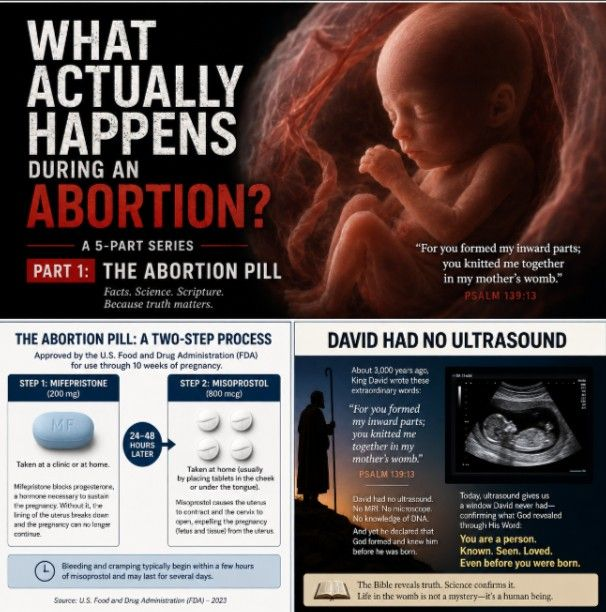
Before discussing how abortions are performed, I want to make clear where I stand and why.
I believe human life is sacred because it is created by God. Scripture does not speak about the unborn as meaningless tissue or as human beings only after birth. David says to God, “For you formed my inward parts; you knitted me together in my mother's womb” (Psalm 139:13, ESV). He continues, “Your eyes saw my unformed substance” (Psalm 139:16, ESV).
The prophet Jeremiah records God saying, “Before I formed you in the womb I knew you, and before you were born I consecrated you” (Jeremiah 1:5, ESV). In Luke's Gospel, when the pregnant Mary visits Elizabeth, Elizabeth says that “the baby in my womb leaped for joy” (Luke 1:44, ESV).
For me, these passages establish an unmistakable biblical principle: the child in the womb is known by God, formed by God and treated in Scripture as human life worthy of dignity. Scripture is not a biology textbook and these verses do not identify a scientific instant at which biological life begins. They do, however, make my Christian position on abortion clear. The unborn child is not disposable property. That child bears profound value before God.
David Had No Ultrasound
Think about this for a moment. David lived roughly 3,000 years ago. He had no ultrasound, fetal photography, magnetic resonance imaging (MRI) or modern embryology. He could not look through a screen and watch a child developing inside the womb as parents can today.
Yet David wrote, “For you formed my inward parts; you knitted me together in my mother's womb” (Psalm 139:13, ESV). He also wrote, “Your eyes saw my unformed substance” (Psalm 139:16, ESV).
Ancient people certainly understood pregnancy, childbirth, miscarriage and movement of a child within the womb. But they did not possess our modern ability to observe prenatal development directly. Psalm 139 is not a scientific textbook, and I do not claim David possessed modern knowledge of embryology. As a Christian, however, I believe Scripture is inspired by God. David's words describe something remarkably powerful: long before mankind could see inside the womb, he wrote of himself as known by God and being formed there.
Today, ultrasound gives us a window David never had. We can observe prenatal development with our own eyes. Technology did not create the value of unborn human life. It simply allows us to see more clearly what was previously hidden from human sight.
Jesus also gave a terrifying warning about harming children. In Matthew 18:6, He says that whoever causes “one of these little ones who believe in me to sin” would be better off having a great millstone fastened around his neck and being drowned in the sea. The immediate context concerns causing Christ's “little ones” to stumble, so I will not pretend Jesus was specifically describing abortion. But the severity of His warning should stop every Christian in his tracks. Jesus did not treat harm done to the vulnerable as a trivial matter.
And to the reader who does not believe in Christianity, I would ask you to consider the stakes of being wrong. You may reject the Bible, reject my faith and reject my conclusion about abortion. But if the Christian account is true, death is not the end and each of us will ultimately answer to God for what we have done. If I am wrong about abortion, I have defended lives that I believed deserved protection. But if you are wrong, and abortion is the deliberate taking of innocent human life created by God, then this question carries consequences far beyond politics, elections or the few decades we spend on this earth. If you are wrong about abortion, you will one day answer to God for it. That is not a threat from me. It is the eternal consequence I believe Scripture tells every human being to take seriously.
That is the biblical foundation from which I write this article. I believe deliberately killing an unborn human being is a grave moral evil and satanic to its core. I refuse to hide what abortion does behind comfortable language.
Abortion has acquired a vocabulary that makes an extraordinarily serious act sound clinical and distant.
Medication abortion.
Pregnancy tissue.
Emptying the uterus.
Ending a pregnancy.
Those words may be medically familiar, but they can make it easy to forget the central fact at issue: there is a developing human organism inside the uterus, and an induced abortion is performed to end that pregnancy.
I believe deliberately ending that unborn human life is morally wrong. I consider abortion the killing of an unborn human being.
Readers deserve to understand what the procedure actually involves before deciding whether they agree.
The Most Common Method: Medication Abortion
One of the most important abortion methods to understand does not require an operating room.
It involves pills.
The standard U.S. Food and Drug Administration (FDA)-approved regimen through 10 weeks of pregnancy uses two drugs: mifepristone and misoprostol.
Step One: Mifepristone
The woman first takes mifepristone.
The FDA explains that mifepristone blocks progesterone, a hormone needed for the pregnancy to continue. In plain English, the first drug interferes with the hormonal support necessary for the pregnancy to continue. This is not simply a drug that prevents pregnancy from beginning. It is being taken after pregnancy already exists for the purpose of ending that pregnancy. That distinction matters.
Step Two: Misoprostol
Under the FDA-approved regimen, misoprostol is taken 24 to 48 hours later.
Misoprostol causes the uterus to contract. Cramping and bleeding follow, and the contents of the uterus are expelled. The American College of Obstetricians and Gynecologists (ACOG) describes the bleeding as potentially much heavier than a menstrual period and says severe cramping can occur. Nausea, vomiting, fever and chills can also occur. Put plainly, the second drug causes the woman's body to expel the pregnancy. That is what the phrase “the uterus empties” means.
What May Actually Be Passed?
This is an area where accuracy is especially important. What a woman sees depends heavily upon how far the pregnancy has progressed. In very early abortions, the embryo is extremely small and may not be visually identifiable among blood, clots, gestational tissue and the gestational sac. As pregnancy advances, embryonic and later fetal development becomes progressively more recognizable. So we should not falsely claim that every woman taking abortion pills will see a clearly recognizable unborn child. But we should not hide the opposite fact either. The bleeding and tissue being expelled are occurring because a pregnancy that was developing inside her uterus has been intentionally ended.
This Can Happen at Home
There is another major difference between medication and surgical abortion.
The abortion process may take place outside a medical facility. The World Health Organization (WHO) states that, under its recommendations and appropriate circumstances, medication abortion using mifepristone and misoprostol can be self-managed during early pregnancy. ACOG likewise notes that abortion medication may sometimes be obtained following a telehealth visit. That means the cramping, bleeding and passage of the pregnancy may occur in a woman's home rather than an operating room. The location does not change what the drugs are intended to accomplish.
What If the Abortion Is Not Complete?
Medication abortion does not always completely empty the uterus. ACOG states that an incomplete abortion can require additional medication or a procedure to remove what remains. Its clinical guidance also tells patients to seek medical attention for certain warning signs, including extremely heavy bleeding.
This is another reason the phrase “just taking a pill” can create a misleading mental picture. These medications initiate a physical process involving uterine contractions, bleeding and expulsion of the pregnancy.
Call It What It Is
People on opposite sides of the abortion debate will use different moral language. Those who support abortion rights generally describe medication abortion as health care and the termination of a pregnancy. I reject that moral description. From a pro-life perspective, there is a simpler question:
What was alive and developing before the drugs were taken, and what was no longer developing after the drugs accomplished their intended purpose?
The medical terminology should not prevent Americans from confronting that question.
The FDA says mifepristone blocks the progesterone needed for a pregnancy to continue.
ACOG says misoprostol produces cramping and bleeding that causes the uterus to empty.
Those are not claims from a pro-life organization.
Those are descriptions from the federal agency regulating the drug and one of America's leading professional organizations for obstetricians and gynecologists.
I call the deliberate destruction of unborn human life what I believe it is:
The killing of an unborn human being.
And the farther we go into the procedures used later in pregnancy, the harder the physical reality becomes to ignore.
Sources
U.S. Food and Drug Administration (FDA): Questions and Answers on Mifepristone for Medical Termination of Pregnancy Through Ten Weeks Gestation. The FDA explains that mifepristone blocks progesterone needed for a pregnancy to continue, describes its use with misoprostol through 10 weeks of gestation, and gives the approved 24-to-48-hour interval between the two drugs.
American College of Obstetricians and Gynecologists (ACOG): Medication Abortion Up to 70 Days of Gestation. ACOG's clinical guidance describes medication abortion using medicines rather than uterine aspiration to induce an abortion.
World Health Organization (WHO): Abortion Care Guideline, Second Edition and WHO Recommendations on Self-Care Interventions: Self-Management of Medical Abortion. WHO's current guidance addresses medication abortion and states that medical abortion in early pregnancy can, under its recommendations and appropriate circumstances, be self-managed outside a health-care facility.
Next: Suction Aspiration. What actually happens when an abortion is performed using a vacuum device?
Latest Articles, Submissions & Community Highlights
Participating groups, neighborhood leaders, and citizen coalitions can share news, documents, or resources here.